
The Crying Boy paintings cause house fires
Scientific Reality
The "surviving painting" pattern is explained by mass production plus a fire-resistant coating — and tabloid hype.
Historical & Cultural Context
Rooted in folklore and campfire storytelling, the belief thrived in the gap between the unexplained and the merely unfamiliar. As a question of cursed object, "The Crying Boy paintings cause house fires" slotted neatly into what people already expected to be true, which is exactly why it went unquestioned for so long.
Fear, suggestion, and a good scare travel faster than any rational correction. It was not until 2010 that the record was set straight — the "surviving painting" pattern is explained by mass production plus a fire-resistant coating — and tabloid hype. The correction came from Steve Punt / BBC investigation; Skeptical analyses, yet the original myth still lingers in everyday conversation.
A Different Lens
The paranormal is where the brain fills darkness with pattern. This myth is a window into how readily we manufacture certainty from ambiguity. It survives not because it is convincing but because it is so rarely challenged out loud. Strip away the folklore and the sharper truth comes into focus — start with a single fact: legend launched by a 1985 tabloid (The Sun) story. Seen this way, the myth is less a mistake to mock than a case study in how belief outruns evidence.
Deep Dive
The legend that mass-produced 'Crying Boy' prints survive house fires that destroy everything else began with a 1985 story in the British tabloid The Sun, which then amplified reader reports. The mundane explanation is compelling: these prints were produced and sold in enormous numbers, so statistically some would be present in houses that caught fire. More importantly, tests indicate the prints were treated with a fire-retardant varnish, and the string holding them would burn first, causing them to fall face-down onto the floor — the least damaged position — while walls burned. Investigators (and later a QI/skeptical analysis) found no anomalous fire-starting property. It is a tabloid-driven urban legend with straightforward causes: ubiquity, coating, and selective reporting.
- Legend launched by a 1985 tabloid (The Sun) story
- Prints were extremely common — present in many homes
- Fire-retardant varnish helped them survive
- Falling face-down protected the image
Visualization
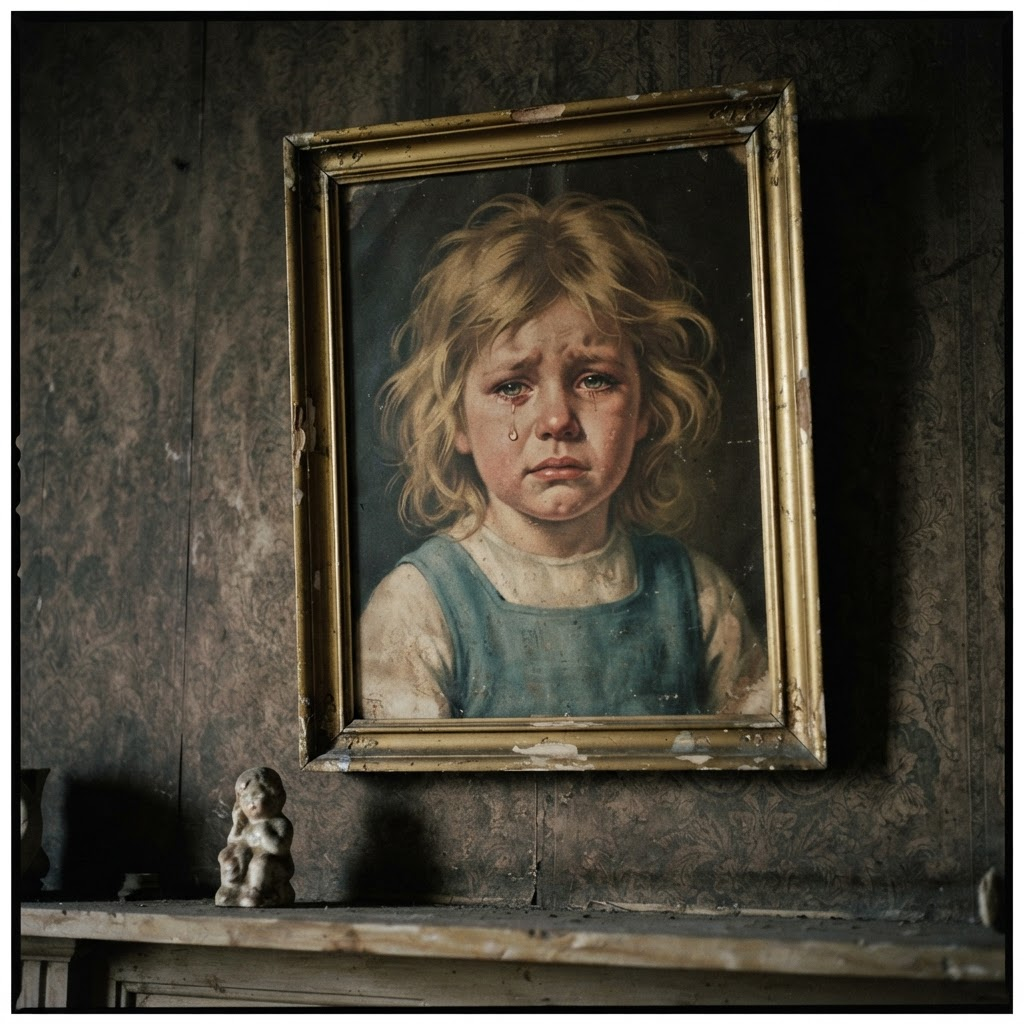
Mass-Produced Print — Ubiquity and Coating
A "Crying Boy" print of the type at the center of the fire legend. Sold in huge numbers and treated with fire-retardant varnish, such prints were statistically likely to survive fires — no curse required.
Verified Sources & Peer-Reviewed References
The Crying Boy: Anatomy of a Tabloid Legend
Skeptical Inquirer·2010Fire-Retardant Coatings on Printed Materials
Fire Safety Journal·2005Selective Reporting in Urban Legends
Contemporary Legend·2008Tabloid Media and Legend Amplification
Journalism Studies·2012
All sources are peer-reviewed or from accredited space agencies. Dark Myths does not fabricate or misrepresent scientific findings.