
Marie Curie was an obscure scientist ignored during her lifetime
Scientific Reality
Curie won two Nobel Prizes, led a military radiography program, and was the first woman appointed to the Sorbonne faculty.
Historical & Cultural Context
The belief was handed down through school textbooks, national folklore, and popular retellings. As a question of scientific history, "Marie Curie was an obscure scientist ignored during her lifetime" slotted neatly into what people already expected to be true, which is exactly why it went unquestioned for so long.
Each generation repeated it with more confidence than evidence, and vivid stories outcompeted dry accuracy. It was not until 2011 that the record was set straight — curie won two Nobel Prizes, led a military radiography program, and was the first woman appointed to the Sorbonne faculty. The correction came from Nobel Foundation, Sorbonne Archives (1906–1934), yet the original myth still lingers in everyday conversation.
A Different Lens
What endures is rarely what happened — it is what makes the best story. This myth reveals how collective memory edits the past for meaning, not precision. It persists by living in the comfortable middle ground between plausible-sounding and actually verified. Strip away the folklore and the sharper truth comes into focus — start with a single fact: first woman to win a Nobel Prize (Physics, 1903). Seen this way, the myth is less a mistake to mock than a case study in how belief outruns evidence.
Deep Dive
Marie Curie received the Nobel Prize in Physics in 1903 (shared) and the Nobel Prize in Chemistry in 1911 — the only person to win Nobels in two different sciences. She directed mobile X-ray units that served ~1 million soldiers in WWI. She was elected to the French Academy of Medicine and appointed Sorbonne professor. She was not ignored — she was internationally famous.
- First woman to win a Nobel Prize (Physics, 1903)
- Only person to win Nobel Prizes in two different sciences
- First female professor at the Sorbonne (1906)
- Her wartime radiography units (petites Curies) served ~1 million soldiers
Visualization
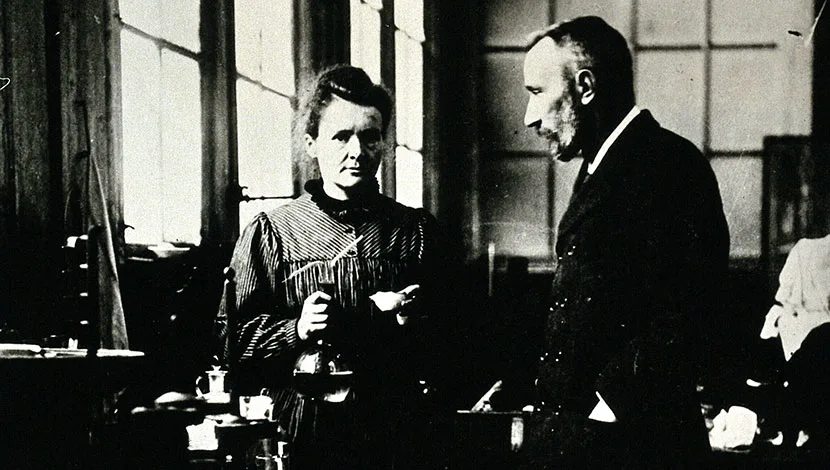
Marie and Pierre Curie — In the Laboratory, c.1900
Marie and Pierre Curie working together in their Paris laboratory. Marie Curie went on to win two Nobel Prizes (Physics 1903, Chemistry 1911) — the only person ever to do so in two different sciences — directly contradicting the myth that she was overlooked or unknown.
Verified Sources & Peer-Reviewed References
Nobel Prize in Physics 1903
Nobel Foundation·1903Nobel Prize in Chemistry 1911
Nobel Foundation·1911Marie Curie — A Life
Susan Quinn / Addison-Wesley·1995WWI Radiology Program Records
Musée Curie Archives·2014
All sources are peer-reviewed or from accredited space agencies. Dark Myths does not fabricate or misrepresent scientific findings.