
Chemtrails are chemical weapons sprayed by governments
Scientific Reality
Contrails are ice crystals formed when hot engine exhaust meets cold, humid stratospheric air.
Historical & Cultural Context
In an era of institutional distrust, the claim spread through alternative media, forums, and word of mouth. As a question of conspiracy, "Chemtrails are chemical weapons sprayed by governments" slotted neatly into what people already expected to be true, which is exactly why it went unquestioned for so long.
It fed on the seductive appeal of hidden knowledge and the thrill of seeing what "they" supposedly concealed. It was not until 2016 that the record was set straight — contrails are ice crystals formed when hot engine exhaust meets cold, humid stratospheric air. The correction came from Environmental Research Letters, Shearer et al. (2016); FAA/ICAO Aircraft Emissions Standards, yet the original myth still lingers in everyday conversation.
A Different Lens
Conspiracy beliefs are less about evidence than about identity and control. This one shows how the feeling of being an insider outweighs the facts. It survives not because it is convincing but because it is so rarely challenged out loud. Strip away the folklore and the sharper truth comes into focus — start with a single fact: contrail formation: ice crystallisation at −40 °C to −60 °C at cruise altitude. Seen this way, the myth is less a mistake to mock than a case study in how belief outruns evidence.
Deep Dive
Aircraft contrails (condensation trails) form when hot, moist exhaust gases from jet engines mix with cold, low-pressure air at altitude (typically 8–13 km). Water vapour instantly freezes into ice crystals. Persistence depends on atmospheric humidity: in dry air contrails disappear within seconds; in moist air they can persist for hours and spread into cirrus-like clouds. A 2016 survey of 77 atmospheric scientists — 76 of whom had relevant expertise — found 77 rejected the chemtrail hypothesis. Commercial jet fuel (Jet-A) is kerosene; its combustion products are CO₂, H₂O, NOₓ, and soot — all well-characterised.
- Contrail formation: ice crystallisation at −40 °C to −60 °C at cruise altitude
- Persistence correlates with relative humidity over ice (RHi) — a standard meteorological variable
- 2016 survey: 77/77 atmospheric scientists found no evidence of secret spraying
- Commercial Jet-A fuel composition is publicly certified and independently tested
Visualization
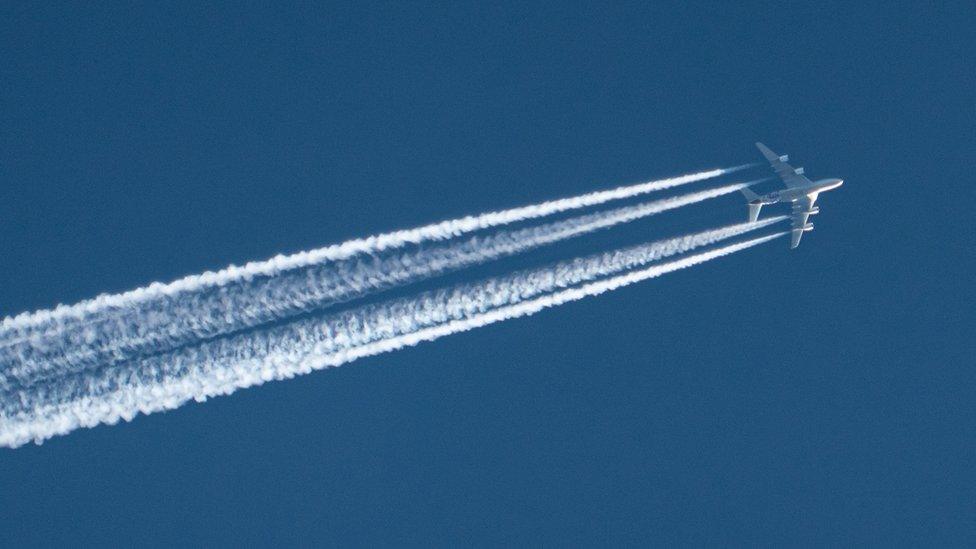
Commercial Jet Contrails — High-Altitude Ice Crystal Formation
Commercial aircraft leaving persistent contrails at cruise altitude (~10,600 m). Contrail persistence is a direct function of atmospheric relative humidity over ice — no chemical spraying involved. This image is consistent with standard NOAA meteorological models.
Verified Sources & Peer-Reviewed References
Quantifying Expert Consensus Against the Chemtrail Hypothesis
Environmental Research Letters·2016Contrail Formation and Climate Effects
NASA Langley Research Center·2018Aircraft Engine Emissions Standards
ICAO Environmental Protection Committee·2022Cirrus Cloud Formation from Contrails
Atmospheric Chemistry and Physics·2020
All sources are peer-reviewed or from accredited space agencies. Dark Myths does not fabricate or misrepresent scientific findings.