
The Codex Gigas was written in one night with the Devil's help
Scientific Reality
Handwriting analysis shows a single scribe over ~20–30 years — consistent, not miraculous or diabolical.
Historical & Cultural Context
The belief was handed down through school textbooks, national folklore, and popular retellings. As a question of manuscript, "The Codex Gigas was written in one night with the Devil's help" slotted neatly into what people already expected to be true, which is exactly why it went unquestioned for so long.
Each generation repeated it with more confidence than evidence, and vivid stories outcompeted dry accuracy. It was not until 2007 that the record was set straight — handwriting analysis shows a single scribe over ~20–30 years — consistent, not miraculous or diabolical. The correction came from National Library of Sweden research; palaeographic analysis, yet the original myth still lingers in everyday conversation.
A Different Lens
What endures is rarely what happened — it is what makes the best story. This myth reveals how collective memory edits the past for meaning, not precision. It persists by living in the comfortable middle ground between plausible-sounding and actually verified. Strip away the folklore and the sharper truth comes into focus — start with a single fact: real 13th-century Bohemian manuscript (~92 cm, ~75 kg). Seen this way, the myth is less a mistake to mock than a case study in how belief outruns evidence.
Deep Dive
The Codex Gigas ('Giant Book'), or 'Devil's Bible,' is a real 13th-century manuscript from Bohemia, famous for its size (~92 cm tall, ~75 kg) and a full-page portrait of the devil. Legend says a condemned monk wrote it in one night with Satan's help. In reality, palaeographic and codicological study (including work associated with the National Library of Sweden) shows remarkably uniform handwriting consistent with a single scribe working over roughly two to three decades — a plausible lifetime project for a dedicated monk. The uniformity that inspired the 'one night' legend actually reflects sustained, disciplined craftsmanship. The devil illustration fits medieval religious themes of sin and redemption. It is an extraordinary human achievement, not a supernatural one.
- Real 13th-century Bohemian manuscript (~92 cm, ~75 kg)
- Uniform handwriting points to one scribe over ~20–30 years
- Consistency inspired the "one night" legend
- Devil portrait reflects medieval religious themes
Visualization
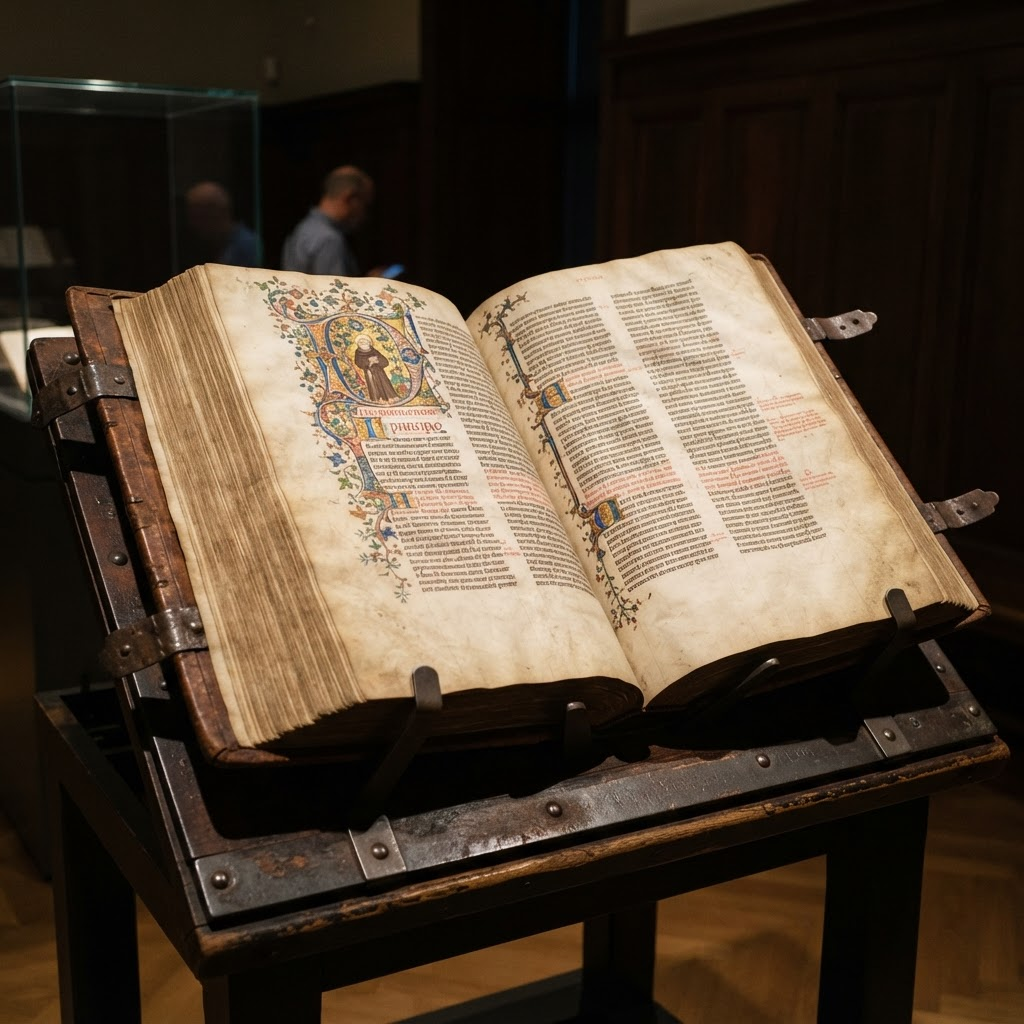
Codex Gigas — Decades of a Single Hand
The enormous Codex Gigas. Palaeographic analysis shows uniform handwriting consistent with one scribe working over decades — the very consistency that inspired the "written in one night with the Devil" legend.
Verified Sources & Peer-Reviewed References
The Codex Gigas: Codicological Study
National Library of Sweden·2007Palaeographic Analysis of Single-Scribe Manuscripts
Scriptorium·2009Devil Iconography in Medieval Manuscripts
Journal of Medieval History·2011Production of Large Format Codices
The Library·2008
All sources are peer-reviewed or from accredited space agencies. Dark Myths does not fabricate or misrepresent scientific findings.