
Columbus proved the Earth was round
Scientific Reality
Educated Europeans knew the Earth was spherical since ancient Greece — Columbus just wildly underestimated its size.
Historical & Cultural Context
The belief was handed down through school textbooks, national folklore, and popular retellings. As a question of world history, "Columbus proved the Earth was round" slotted neatly into what people already expected to be true, which is exactly why it went unquestioned for so long.
Each generation repeated it with more confidence than evidence, and vivid stories outcompeted dry accuracy. It was not until 1945 that the record was set straight — educated Europeans knew the Earth was spherical since ancient Greece — Columbus just wildly underestimated its size. The correction came from Jeffrey Burton Russell — 'Inventing the Flat Earth' (1991); Eratosthenes (240 BCE), yet the original myth still lingers in everyday conversation.
A Different Lens
What endures is rarely what happened — it is what makes the best story. This myth reveals how collective memory edits the past for meaning, not precision. It persists by living in the comfortable middle ground between plausible-sounding and actually verified. Strip away the folklore and the sharper truth comes into focus — start with a single fact: eratosthenes calculated Earth circumference: 39,375 km (actual: 40,075 km). Seen this way, the myth is less a mistake to mock than a case study in how belief outruns evidence.
Deep Dive
Eratosthenes calculated Earth's circumference to within 2% accuracy in 240 BCE. Educated medieval Europeans universally accepted a spherical Earth. Spanish scholars opposed Columbus not because they feared he'd fall off an edge, but because they correctly calculated the Earth was too large for his ships to survive the journey to Asia. They were right — he accidentally found the Americas instead.
- Eratosthenes calculated Earth circumference: 39,375 km (actual: 40,075 km)
- Columbus estimated Earth's circumference at only 29,000 km — off by 28%
- Spanish royal commission correctly identified his error
- Washington Irving's 1828 biography fabricated the flat-Earth opposition story
Visualization
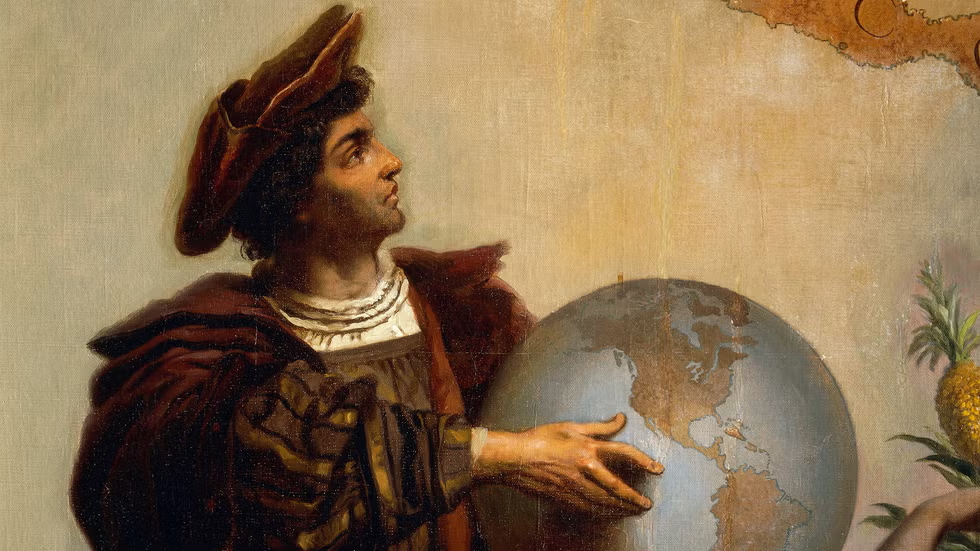
Christopher Columbus — Allegorical Portrait, c.1500s
Portrait of Christopher Columbus from an allegorical painting. Columbus sailed not because he believed the Earth was flat — educated Europeans had known it was spherical since Eratosthenes (240 BCE) — but because he wildly underestimated its circumference.
Verified Sources & Peer-Reviewed References
Jeffrey Burton Russell — Inventing the Flat Earth
Praeger Publishers·1991Eratosthenes — On the Measurement of the Earth
Library of Alexandria·-240Waldseemüller Map Analysis
Library of Congress·2003Columbus and the Salamanca Commission
American Historical Review·1944
All sources are peer-reviewed or from accredited space agencies. Dark Myths does not fabricate or misrepresent scientific findings.