
The Hope Diamond carries a deadly curse
Scientific Reality
The Hope Diamond's "curse" was largely a marketing and press invention, embellished by jeweler Pierre Cartier.
Historical & Cultural Context
The belief was handed down through school textbooks, national folklore, and popular retellings. As a question of cursed object, "The Hope Diamond carries a deadly curse" slotted neatly into what people already expected to be true, which is exactly why it went unquestioned for so long.
Each generation repeated it with more confidence than evidence, and vivid stories outcompeted dry accuracy. It was not until 2006 that the record was set straight — the Hope Diamond's "curse" was largely a marketing and press invention, embellished by jeweler Pierre Cartier. The correction came from Kurin, R. — Hope Diamond: The Legendary History of a Cursed Gem (2006), yet the original myth still lingers in everyday conversation.
A Different Lens
What endures is rarely what happened — it is what makes the best story. This myth reveals how collective memory edits the past for meaning, not precision. It survives not because it is convincing but because it is so rarely challenged out loud. Strip away the folklore and the sharper truth comes into focus — start with a single fact: a real 45.52-carat blue diamond at the Smithsonian. Seen this way, the myth is less a mistake to mock than a case study in how belief outruns evidence.
Deep Dive
The Hope Diamond is a real 45.52-carat deep-blue diamond, now at the Smithsonian. Its 'curse' — tales of doom befalling owners — was substantially fabricated. Historians note that jeweler Pierre Cartier elaborated and promoted a dramatic curse story in the early 1900s to entice buyer Evalyn Walsh McLean, and sensational newspapers amplified it. Many 'cursed' owners in the legend either never existed or did not own the stone. Statistically, tracing any famous object across centuries will find some owners who met misfortune — that is expected, not anomalous. Since 1958 the diamond has sat safely in the Smithsonian, viewed by millions, with no pattern of calamity. The curse is a story, deliberately told to add value and intrigue.
- A real 45.52-carat blue diamond at the Smithsonian
- Curse story promoted by jeweler Pierre Cartier to sell it
- Several "cursed owners" are fictional or never owned it
- Safe in the Smithsonian since 1958 with no calamity
Visualization
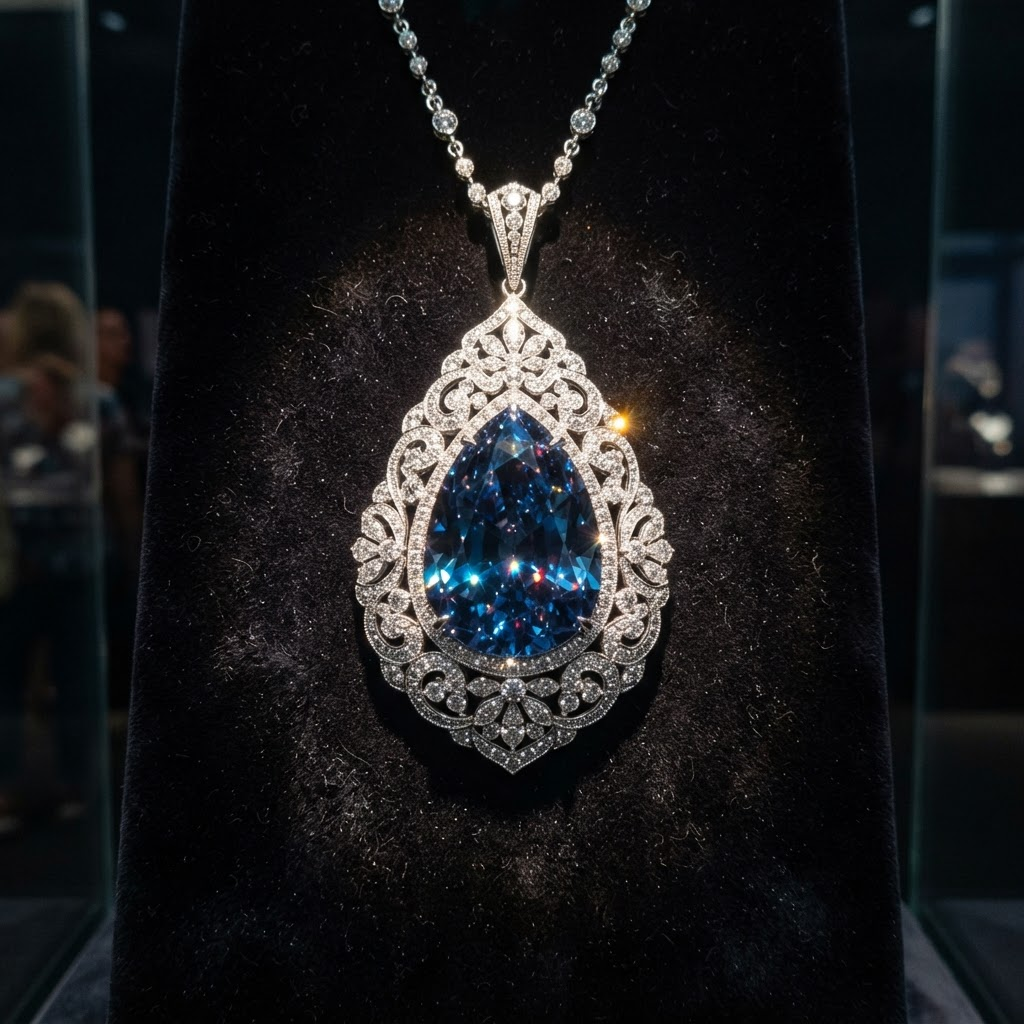
The Hope Diamond — Smithsonian Collection
The 45.52-carat blue Hope Diamond in its pendant setting. Its famous "curse" was largely a sales device promoted by jeweler Pierre Cartier and amplified by the press — several cursed owners in the tale never even existed.
Verified Sources & Peer-Reviewed References
Hope Diamond: The Legendary History of a Cursed Gem
Smithsonian Books·2006The Marketing of Gemstone Provenance
Journal of Gemmology·2010Curse Narratives and Object Biography
Journal of Material Culture·2012Probability and the Illusion of Cursed Objects
Skeptical Inquirer·2008
All sources are peer-reviewed or from accredited space agencies. Dark Myths does not fabricate or misrepresent scientific findings.