
Lightning never strikes the same place twice
Scientific Reality
Tall structures are struck repeatedly. The Empire State Building takes ~23 strikes per year.
Historical & Cultural Context
The belief was handed down through school textbooks, national folklore, and popular retellings. As a question of general folklore, "Lightning never strikes the same place twice" slotted neatly into what people already expected to be true, which is exactly why it went unquestioned for so long.
Each generation repeated it with more confidence than evidence, and vivid stories outcompeted dry accuracy. It was not until 1752 that the record was set straight — tall structures are struck repeatedly. The Empire State Building takes ~23 strikes per year. The correction came from NOAA Lightning Strike Database; Franklin (1752), yet the original myth still lingers in everyday conversation.
A Different Lens
What endures is rarely what happened — it is what makes the best story. This myth reveals how collective memory edits the past for meaning, not precision. It survives not because it is convincing but because it is so rarely challenged out loud. Strip away the folklore and the sharper truth comes into focus — start with a single fact: empire State Building: ~23 lightning strikes per year. Seen this way, the myth is less a mistake to mock than a case study in how belief outruns evidence.
Deep Dive
Lightning follows the path of least resistance to ground. Tall, pointed conductive objects provide that path consistently — which is the entire principle behind Franklin's lightning rod (1752). The Empire State Building averages 23 hits per year. Radio towers, trees, and mountains are struck in the same spots repeatedly across every storm.
- Empire State Building: ~23 lightning strikes per year
- Benjamin Franklin's rod (1752) works precisely because lightning does repeat
- Lightning can return to the same spot multiple times in a single storm
- The myth likely arose as a comforting idiom about bad luck
Visualization
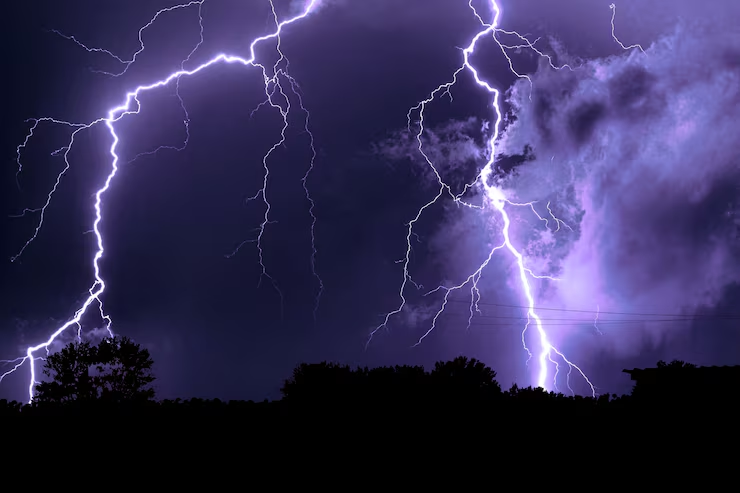
Lightning and Weather Effects — Dramatic Storm Composite
Dramatic weather composite showing multiple lightning strikes and storm phenomena. Benjamin Franklin proved in 1752 that lightning is repeatable and predictable — it is precisely why his rod works. The Empire State Building averages 23 direct strikes per year, and tall radio towers have been struck multiple times in a single storm. Lightning takes the path of least resistance, which is the same tall conductor every time.
Verified Sources & Peer-Reviewed References
Lightning Strike Statistics — Tall Structures
NOAA National Weather Service·2020Benjamin Franklin's Lightning Rod Proposal
American Philosophical Society·1752Leader Propagation in Repetitive Strikes
Journal of Geophysical Research — Atmospheres·2015Empire State Building Strike Log
NOAA / Empire State Realty Trust·2022
All sources are peer-reviewed or from accredited space agencies. Dark Myths does not fabricate or misrepresent scientific findings.