
The Chupacabra is a blood-sucking livestock predator
Scientific Reality
DNA testing of "Chupacabra" carcasses consistently identifies mange-ridden canids.
Historical & Cultural Context
Rooted in folklore and campfire storytelling, the belief thrived in the gap between the unexplained and the merely unfamiliar. As a question of cryptid, "The Chupacabra is a blood-sucking livestock predator" slotted neatly into what people already expected to be true, which is exactly why it went unquestioned for so long.
Fear, suggestion, and a good scare travel faster than any rational correction. It was not until 2011 that the record was set straight — dNA testing of "Chupacabra" carcasses consistently identifies mange-ridden canids. The correction came from Radford, B. — Tracking the Chupacabra (University of New Mexico Press, 2011), yet the original myth still lingers in everyday conversation.
A Different Lens
The paranormal is where the brain fills darkness with pattern. This myth is a window into how readily we manufacture certainty from ambiguity. It survives not because it is convincing but because it is so rarely challenged out loud. Strip away the folklore and the sharper truth comes into focus — start with a single fact: all tested carcasses are coyotes, dogs, or hybrids with mange. Seen this way, the myth is less a mistake to mock than a case study in how belief outruns evidence.
Deep Dive
The Chupacabra legend began in Puerto Rico in 1995; biologist Benjamin Radford traced the original description to an eyewitness who had recently seen the sci-fi film Species. Every physical 'Chupacabra' carcass recovered — especially the hairless Texas specimens — has been DNA-tested and identified as a coyote, dog, or coyote-dog hybrid suffering from Sarcoptes scabiei (mange). Mange causes hair loss, thickened greyish skin, and emaciation, producing a bizarre appearance. The 'bloodless' livestock claim is also false: predators do not drain blood, and carcasses left in the sun simply show minimal external bleeding while internal decomposition proceeds normally.
- All tested carcasses are coyotes, dogs, or hybrids with mange
- Sarcoptes scabiei causes hair loss and thickened grey skin
- Original 1995 description traced to the film "Species"
- Predators do not "drain" blood — a persistent myth
Visualization
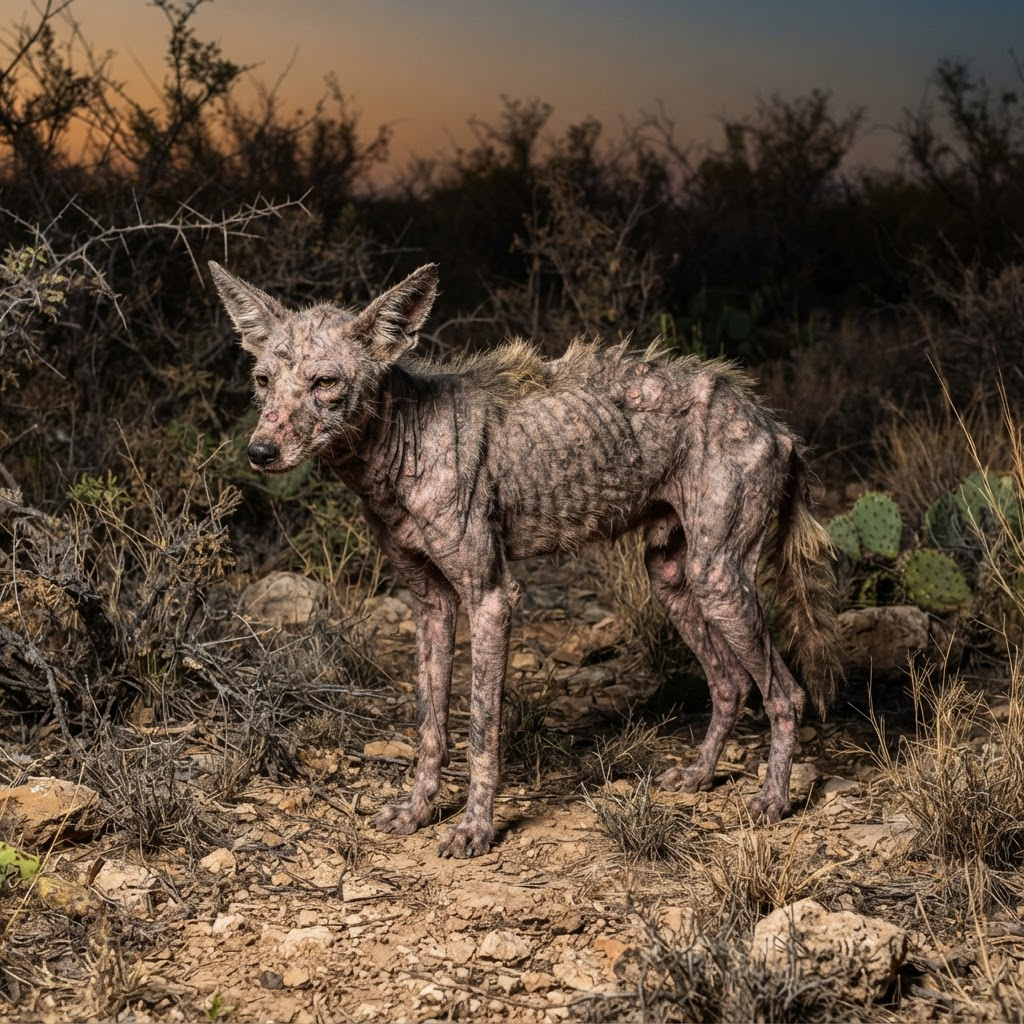
Mange-Affected Canid — Typical "Chupacabra" Specimen Profile
Composite reference of a hairless, mange-afflicted coyote — the animal repeatedly recovered and misidentified as a Chupacabra. Sarcoptic mange produces the greyish thickened skin, spinal ridge, and gaunt frame that fuel the legend.
Verified Sources & Peer-Reviewed References
Tracking the Chupacabra: The Vampire Beast in Fact and Fiction
University of New Mexico Press·2011DNA Identification of Alleged Chupacabra Carcasses
Journal of Mammalogy·2010Sarcoptic Mange in Wild Canids
Journal of Wildlife Diseases·2008Post-Mortem Blood Pooling and Predation Myths
Veterinary Pathology·2013
All sources are peer-reviewed or from accredited space agencies. Dark Myths does not fabricate or misrepresent scientific findings.