The Moon has a permanent dark side
Scientific Reality
The far side of the Moon receives just as much sunlight as the near side.
Historical & Cultural Context
For most of human history the cosmos was read through the naked eye and the stories cultures told to explain the night sky. As a question of lunar science, "The Moon has a permanent dark side" slotted neatly into what people already expected to be true, which is exactly why it went unquestioned for so long.
Textbooks, science fiction, and secondhand summaries repeated the claim until it felt like settled fact. It was not until 1959 that the record was set straight — the far side of the Moon receives just as much sunlight as the near side. The correction came from Soviet Luna 3 (1959), China's CNSA Chang'e 4 (2019), yet the original myth still lingers in everyday conversation.
A Different Lens
This myth is less about space itself and more about the limits of human perception and scale — our intuition simply was not built for cosmic distances. It survives not because it is convincing but because it is so rarely challenged out loud. Strip away the folklore and the sharper truth comes into focus — start with a single fact: lunar day lasts ~29.5 Earth days. Seen this way, the myth is less a mistake to mock than a case study in how belief outruns evidence.
Deep Dive
The Moon is tidally locked to Earth, meaning the same face always points at us — but it still rotates relative to the Sun. Each side experiences about 14 Earth-days of sunlight and 14 of darkness. The 'dark side' label simply means the side we never see from Earth.
- Lunar day lasts ~29.5 Earth days
- Both sides receive equal average solar illumination
- Soviet Luna 3 first photographed the far side in 1959
- China's Chang'e 4 landed on the far side in 2019
Visualization
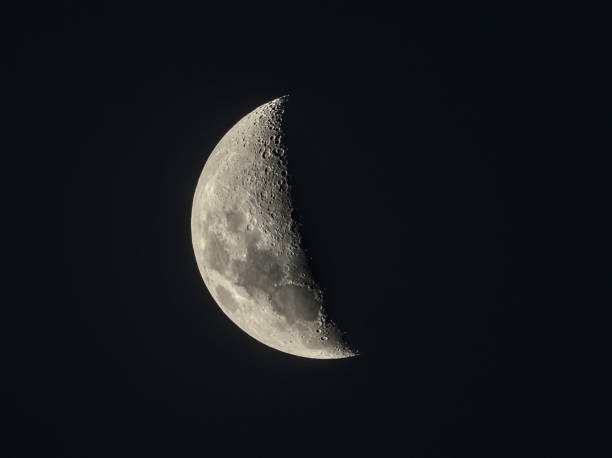
Waxing Crescent Moon — Quarter Phase Illumination
Telephoto photograph of the Moon at approximately first-quarter phase, showing clear solar illumination on the visible (near) side. The terminator line confirms the Moon rotates relative to the Sun — the 'dark side' (far side) receives just as much sunlight as this face, on a 29.5-day cycle.
Verified Sources & Peer-Reviewed References
Luna 3 Far Side Photographs
Soviet Academy of Sciences·1959Chang'e 4 Landing Report
China National Space Administration·2019Tidal Locking Mechanics
Celestial Mechanics & Dynamical Astronomy·2004Lunar Illumination Cycle
NASA Lunar Science Institute·2012
All sources are peer-reviewed or from accredited space agencies. Dark Myths does not fabricate or misrepresent scientific findings.