
The Easter Island statues are an unsolvable mystery
Scientific Reality
Experiments showed the Moai were "walked" upright with ropes — and oral tradition said so all along.
Historical & Cultural Context
Passed down from antiquity through oral tradition and early chroniclers, the story gathered embellishments with every retelling. As a question of archaeology, "The Easter Island statues are an unsolvable mystery" slotted neatly into what people already expected to be true, which is exactly why it went unquestioned for so long.
Distance in time let speculation calcify into "what everyone knows" about the ancient world. It was not until 2012 that the record was set straight — experiments showed the Moai were "walked" upright with ropes — and oral tradition said so all along. The correction came from Hunt, T. & Lipo, C. — The Statues That Walked (2011); Journal of Archaeological Science (2013), yet the original myth still lingers in everyday conversation.
A Different Lens
We project our own assumptions backward onto the ancients. This myth shows how the past becomes a mirror for the present. It persists by living in the comfortable middle ground between plausible-sounding and actually verified. Strip away the folklore and the sharper truth comes into focus — start with a single fact: ~900 Moai carved at the Rano Raraku quarry (c. 1250–1500 CE). Seen this way, the myth is less a mistake to mock than a case study in how belief outruns evidence.
Deep Dive
The nearly 900 Moai of Rapa Nui were carved from volcanic tuff at the Rano Raraku quarry between roughly 1250 and 1500 CE. In 2012, archaeologists Terry Hunt and Carl Lipo demonstrated that a standing Moai could be 'walked' by teams rocking it side to side with ropes — matching Rapa Nui oral tradition that the statues 'walked' to their platforms. Unfinished statues still in the quarry reveal the carving sequence. The older 'ecocide' collapse narrative has also been revised: recent evidence suggests a more resilient society and that European contact, disease, and slave raiding drove the population decline. The island's story is a subject of active, evidence-based archaeology — not an unsolvable enigma.
- ~900 Moai carved at the Rano Raraku quarry (c. 1250–1500 CE)
- 2012 experiment: statues "walked" upright with ropes
- Rapa Nui oral tradition long said the Moai "walked"
- Collapse narrative revised — contact-era disease and raiding
Visualization
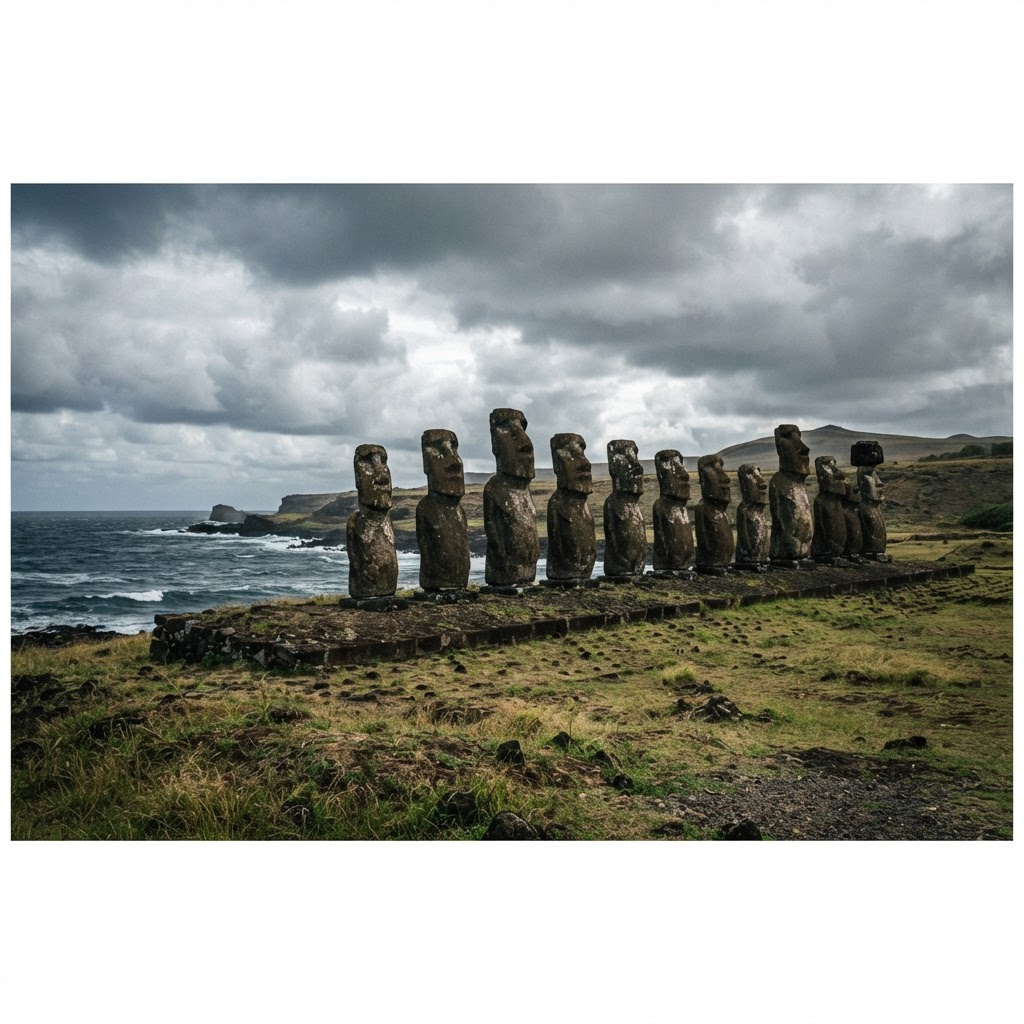
Rapa Nui — Moai Line Under Overcast Sky
A row of Moai on their ceremonial platforms. Carved at the Rano Raraku quarry and transported upright by "walking" with ropes, the statues reflect sophisticated Rapa Nui engineering documented by both experiment and oral tradition.
Verified Sources & Peer-Reviewed References
The Statues That Walked
Free Press·2011Experimental Transport of Rapa Nui Statues
Journal of Archaeological Science·2013Rethinking the Fall of Easter Island
American Scientist·2006Chronology of Moai Construction
Antiquity·2011
All sources are peer-reviewed or from accredited space agencies. Dark Myths does not fabricate or misrepresent scientific findings.