
The Nazca Lines were made by or for aliens
Scientific Reality
Experiments proved a few people can reproduce the geoglyphs with rope, stakes, and basic geometry.
Historical & Cultural Context
Passed down from antiquity through oral tradition and early chroniclers, the story gathered embellishments with every retelling. As a question of archaeology, "The Nazca Lines were made by or for aliens" slotted neatly into what people already expected to be true, which is exactly why it went unquestioned for so long.
Distance in time let speculation calcify into "what everyone knows" about the ancient world. It was not until 1982 that the record was set straight — experiments proved a few people can reproduce the geoglyphs with rope, stakes, and basic geometry. The correction came from Nickell, J., "The Nazca Drawings Revisited," Skeptical Inquirer (1983), yet the original myth still lingers in everyday conversation.
A Different Lens
We project our own assumptions backward onto the ancients. This myth shows how the past becomes a mirror for the present. It survives not because it is convincing but because it is so rarely challenged out loud. Strip away the folklore and the sharper truth comes into focus — start with a single fact: made ~500 BCE–500 CE by removing dark surface stones. Seen this way, the myth is less a mistake to mock than a case study in how belief outruns evidence.
Deep Dive
The Nazca Lines were created by the Nazca culture between roughly 500 BCE and 500 CE by removing the dark oxidised surface stones to expose lighter ground beneath. Explorer Joe Nickell and others demonstrated in 1982 that a small team using only wooden stakes, cord, and simple proportional scaling could reproduce a full-size figure with striking accuracy in days — no aerial viewpoint required. The lines survive because the Nazca desert is one of the driest, most windless places on Earth. Their purpose was likely ritual, astronomical, or water-related. Attributing them to aliens ignores both the achievable engineering and the sophisticated indigenous culture that made them.
- Made ~500 BCE–500 CE by removing dark surface stones
- 1982 experiment reproduced a figure with rope and stakes
- No aerial view needed — proportional scaling suffices
- Preserved by an exceptionally dry, windless climate
Visualization
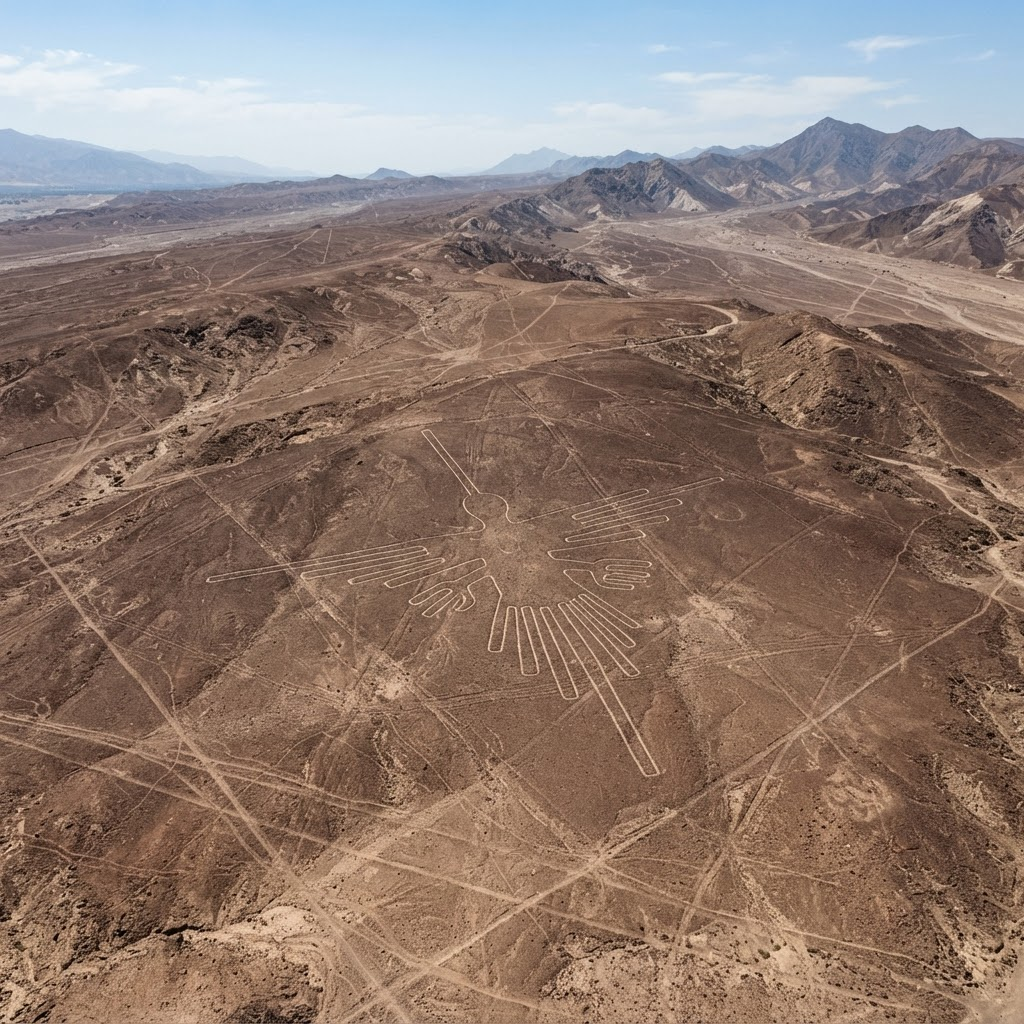
Nazca Plateau — Hummingbird Geoglyph (Aerial)
The hummingbird geoglyph etched into the Peruvian desert. Reproduction experiments show such figures are achievable with rope, stakes, and proportional scaling by a small team — no aerial vantage or outside technology required.
Verified Sources & Peer-Reviewed References
The Nazca Drawings Revisited
Skeptical Inquirer·1983Nazca Geoglyphs: Construction and Chronology
Journal of Archaeological Science·2000Ritual Landscapes of the Nazca
Latin American Antiquity·2008Desert Preservation and Surface Processes
Geomorphology·2012
All sources are peer-reviewed or from accredited space agencies. Dark Myths does not fabricate or misrepresent scientific findings.