The crystal skulls are ancient Aztec or Maya artifacts
Scientific Reality
Electron microscopy revealed rotary-tool marks impossible for pre-Columbian craftsmen — the skulls are modern.
Historical & Cultural Context
Passed down from antiquity through oral tradition and early chroniclers, the story gathered embellishments with every retelling. As a question of archaeology, "The crystal skulls are ancient Aztec or Maya artifacts" slotted neatly into what people already expected to be true, which is exactly why it went unquestioned for so long.
Distance in time let speculation calcify into "what everyone knows" about the ancient world. It was not until 2008 that the record was set straight — electron microscopy revealed rotary-tool marks impossible for pre-Columbian craftsmen — the skulls are modern. The correction came from Sax et al., Journal of Archaeological Science (2008), yet the original myth still lingers in everyday conversation.
A Different Lens
We project our own assumptions backward onto the ancients. This myth shows how the past becomes a mirror for the present. It survives not because it is convincing but because it is so rarely challenged out loud. Strip away the folklore and the sharper truth comes into focus — start with a single fact: sEM analysis found modern rotary-tool and abrasive marks. Seen this way, the myth is less a mistake to mock than a case study in how belief outruns evidence.
Deep Dive
The famous crystal skulls, long claimed to be ancient Mesoamerican (Aztec or Maya) relics with mystical powers, are 19th-century (or later) fakes. Scientific analysis by the British Museum and Smithsonian used scanning electron microscopy to examine the tool marks: the skulls show the telltale signs of rotary cutting wheels and modern abrasives (like carborundum) that did not exist in pre-Columbian America. Provenance research traced many to the French antiquities dealer Eugène Boban in the 1800s. No crystal skull has ever been recovered from a documented archaeological excavation. The 'ancient artifact' and 'psychic powers' claims have no support — they are attractive forgeries turned into modern legend.
- SEM analysis found modern rotary-tool and abrasive marks
- Traced to 19th-century dealer Eugène Boban
- None recovered from any documented excavation
- Materials/techniques postdate pre-Columbian America
Visualization
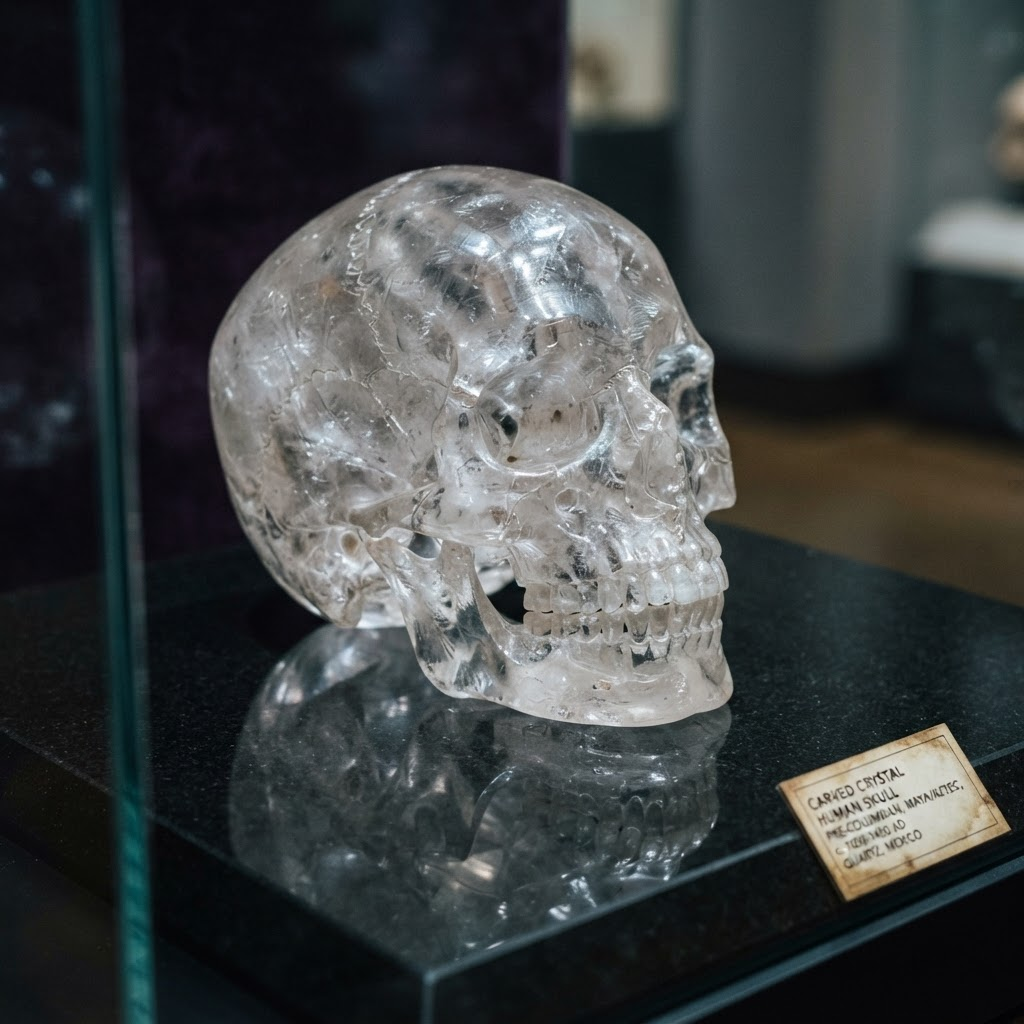
Carved Quartz Skull — Tool-Mark Analysis
A carved quartz crystal skull. Electron microscopy of such skulls reveals rotary-wheel tool marks and modern abrasives unavailable to pre-Columbian carvers — identifying them as 19th-century forgeries, not ancient relics.
Verified Sources & Peer-Reviewed References
The Origins of Two Purportedly Pre-Columbian Crystal Skulls
Journal of Archaeological Science·2008Eugène Boban and the Trade in Fake Antiquities
Journal of the History of Collections·2010Scanning Electron Microscopy of Tool Marks
Archaeometry·2007Lapidary Techniques in Mesoamerica
Latin American Antiquity·2005
All sources are peer-reviewed or from accredited space agencies. Dark Myths does not fabricate or misrepresent scientific findings.