
"Et tu, Brute?" were Caesar's actual last words
Scientific Reality
No contemporary source records those words. They were invented by Shakespeare in 1599.
Historical & Cultural Context
The belief was handed down through school textbooks, national folklore, and popular retellings. As a question of world history, ""Et tu, Brute?" were Caesar's actual last words" slotted neatly into what people already expected to be true, which is exactly why it went unquestioned for so long.
Each generation repeated it with more confidence than evidence, and vivid stories outcompeted dry accuracy. It was not until 1599 that the record was set straight — no contemporary source records those words. They were invented by Shakespeare in 1599. The correction came from Suetonius — De Vita Caesarum (121 CE); Shakespeare — Julius Caesar (1599), yet the original myth still lingers in everyday conversation.
A Different Lens
What endures is rarely what happened — it is what makes the best story. This myth reveals how collective memory edits the past for meaning, not precision. It survives not because it is convincing but because it is so rarely challenged out loud. Strip away the folklore and the sharper truth comes into focus — start with a single fact: suetonius (121 CE): possibly said 'καὶ σύ, τέκνον' (Greek, not Latin). Seen this way, the myth is less a mistake to mock than a case study in how belief outruns evidence.
Deep Dive
Suetonius wrote that Caesar said nothing, or possibly uttered a Greek phrase to Brutus — 'καὶ σύ, τέκνον' (you too, child) — though Suetonius himself was uncertain. Plutarch records only that Caesar pulled his toga over his face to die with dignity. Shakespeare invented the famous Latin phrase for dramatic effect in 'Julius Caesar' (1599), writing it ~1,600 years after the event.
- Suetonius (121 CE): possibly said 'καὶ σύ, τέκνον' (Greek, not Latin)
- Plutarch (75 CE): Caesar covered his face and said nothing
- Shakespeare's 'Julius Caesar' (1599) invented the Latin line for theatrical impact
- Caesar was stabbed 23 times; he died within minutes
Visualization
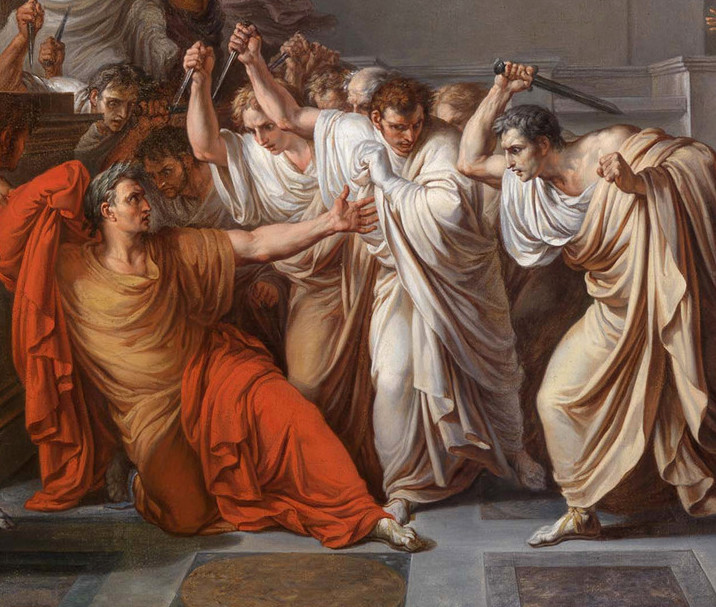
Vincenzo Camuccini — 'The Death of Julius Caesar' (detail, c. 1804)
Detail from Vincenzo Camuccini's monumental oil painting of Caesar's assassination. Caesar is shown being stabbed by senators — he was struck 23 times. No contemporary source records the words 'Et tu, Brute?' Suetonius wrote that Caesar may have said a Greek phrase, or nothing at all. Shakespeare invented the famous Latin line in 1599 CE — 1,618 years after the event.
Verified Sources & Peer-Reviewed References
De Vita Caesarum — Divus Julius
Suetonius / Loeb Classical Library·121Plutarch's Lives — Julius Caesar
Plutarch / Harvard University Press·75Shakespeare's Julius Caesar — First Folio
Shakespeare / Folger Library·1623Historiography of Caesar's Death
Classical Quarterly·2008
All sources are peer-reviewed or from accredited space agencies. Dark Myths does not fabricate or misrepresent scientific findings.