
Puma Punku was too precise for ancient people to build
Scientific Reality
The Tiwanaku culture achieved the precise cuts with stone/bronze tools, templates, and abrasives — documented by archaeology.
Historical & Cultural Context
Passed down from antiquity through oral tradition and early chroniclers, the story gathered embellishments with every retelling. As a question of archaeology, "Puma Punku was too precise for ancient people to build" slotted neatly into what people already expected to be true, which is exactly why it went unquestioned for so long.
Distance in time let speculation calcify into "what everyone knows" about the ancient world. It was not until 2010 that the record was set straight — the Tiwanaku culture achieved the precise cuts with stone/bronze tools, templates, and abrasives — documented by archaeology. The correction came from Protzen & Nair, "The Stones of Tiahuanaco" (2013); Andean archaeology, yet the original myth still lingers in everyday conversation.
A Different Lens
We project our own assumptions backward onto the ancients. This myth shows how the past becomes a mirror for the present. It persists by living in the comfortable middle ground between plausible-sounding and actually verified. Strip away the folklore and the sharper truth comes into focus — start with a single fact: built by the Tiwanaku culture (~536–600 CE). Seen this way, the myth is less a mistake to mock than a case study in how belief outruns evidence.
Deep Dive
Puma Punku, part of the Tiwanaku site in Bolivia (~536–600 CE), is famous for finely cut andesite and sandstone blocks with sharp angles and standardized shapes, which 'ancient aliens' claims call impossible. Archaeology says otherwise: the Tiwanaku were sophisticated stoneworkers who used harder hammerstones, bronze tools, sand-and-water abrasion, and — crucially — reusable templates to reproduce standardized modular pieces (the repetition points to templates, not machines). Experimental archaeology reproduces such surfaces and angles. The stones were quarried nearby and moved with ramps and labor. Attributing it to aliens erases the achievements of an advanced Andean civilization. It is precise, impressive, and entirely within documented pre-Columbian capabilities.
- Built by the Tiwanaku culture (~536–600 CE)
- Standardized shapes indicate reusable templates
- Cut with hammerstones, bronze tools, and abrasion
- Experimental archaeology reproduces the surfaces
Visualization
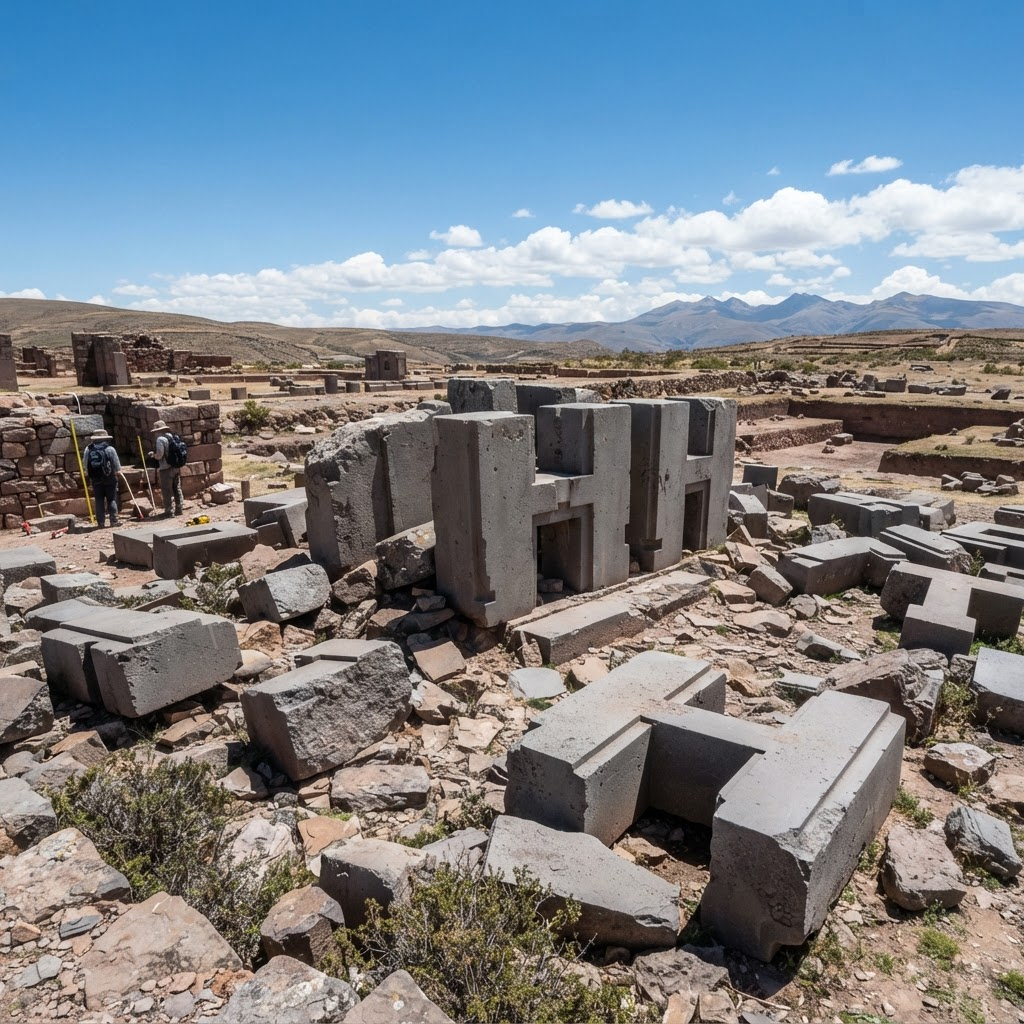
Puma Punku — Templated Andean Stonework
The precisely cut, standardized stone blocks of Puma Punku. Their repetition reflects reusable templates and skilled Tiwanaku craftsmanship with stone and bronze tools — advanced human engineering, not alien technology.
Verified Sources & Peer-Reviewed References
The Stones of Tiahuanaco: A Study of Architecture and Construction
Cotsen Institute of Archaeology·2013Tiwanaku Lithic Technology
Latin American Antiquity·2008Experimental Reproduction of Andesite Cuts
Journal of Archaeological Science·2010Chronology of the Tiwanaku State
Antiquity·2005
All sources are peer-reviewed or from accredited space agencies. Dark Myths does not fabricate or misrepresent scientific findings.