
Different parts of the tongue taste different things
Scientific Reality
All taste-capable tongue regions detect all five basic tastes — the zone map is a mistranslation artifact.
Historical & Cultural Context
Everyday intuition and simplified classroom explanations hardened into "common knowledge" long before careful measurement caught up. As a question of biology, "Different parts of the tongue taste different things" slotted neatly into what people already expected to be true, which is exactly why it went unquestioned for so long.
Because it sounded reasonable and was taught early, few adults ever revisited it. It was not until 1974 that the record was set straight — all taste-capable tongue regions detect all five basic tastes — the zone map is a mistranslation artifact. The correction came from Collings, V.B. (1974) Human Taste Thresholds; Bartoshuk (1993), yet the original myth still lingers in everyday conversation.
A Different Lens
Intuition is a terrible instrument for reality. This myth persists because the truth is counterintuitive — and being wrong felt perfectly logical. It persists by living in the comfortable middle ground between plausible-sounding and actually verified. Strip away the folklore and the sharper truth comes into focus — start with a single fact: original Hanig (1901) paper described "negligible" sensitivity differences. Seen this way, the myth is less a mistake to mock than a case study in how belief outruns evidence.
Deep Dive
German researcher D.P. Hanig published a paper in 1901 showing mild sensitivity differences across tongue regions — differences so small he labelled them 'negligible.' A poor English translation in 1942 amplified the differences into a definitive zone map. In 1974, Virginia Collings confirmed taste buds for all basic tastes (sweet, salty, sour, bitter, umami) are distributed across the entire tongue.
- Original Hanig (1901) paper described "negligible" sensitivity differences
- 1942 English mistranslation converted gradient into hard zones
- Collings (1974) first published definitive disconfirmation
- Taste buds exist on the soft palate, epiglottis, and upper esophagus — not just the tongue
Visualization
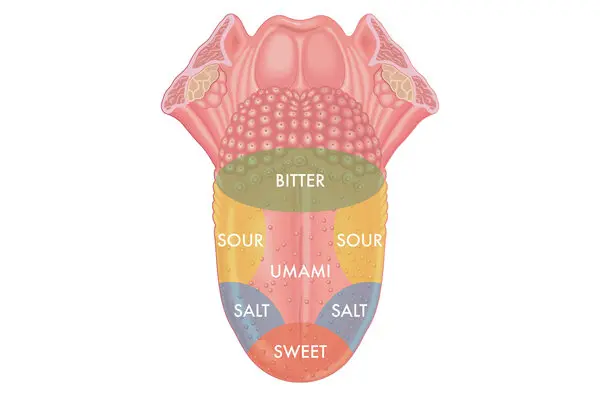
Tongue Taste Zone Map — The Debunked 1942 Diagram
The famous tongue taste zone map, a mistranslation of Hanig's 1901 paper. All five tastes (sweet, salty, sour, bitter, umami) are detected across the entire tongue — this zonal map has been disproved since 1974.
Verified Sources & Peer-Reviewed References
Zur Psychophysik des Geschmackssinnes
D.P. Hanig / Philosophische Studien·1901Human Taste Thresholds
Virginia B. Collings / Chemical Senses·1974Taste Receptor Cell Biology
Cell·2006Neurogastronomy
Gordon M. Shepherd / Columbia UP·2012
All sources are peer-reviewed or from accredited space agencies. Dark Myths does not fabricate or misrepresent scientific findings.