
You would explode in the vacuum of space
Scientific Reality
You would lose consciousness in ~15 seconds, but your body would not explode.
Historical & Cultural Context
For most of human history the cosmos was read through the naked eye and the stories cultures told to explain the night sky. As a question of biology, "You would explode in the vacuum of space" slotted neatly into what people already expected to be true, which is exactly why it went unquestioned for so long.
Textbooks, science fiction, and secondhand summaries repeated the claim until it felt like settled fact. It was not until 1965 that the record was set straight — you would lose consciousness in ~15 seconds, but your body would not explode. The correction came from NASA JSC Vacuum Incident Report (1965), Space Medicine Studies, yet the original myth still lingers in everyday conversation.
A Different Lens
This myth is less about space itself and more about the limits of human perception and scale — our intuition simply was not built for cosmic distances. It persists by living in the comfortable middle ground between plausible-sounding and actually verified. Strip away the folklore and the sharper truth comes into focus — start with a single fact: loss of consciousness: ~15 seconds without oxygen. Seen this way, the myth is less a mistake to mock than a case study in how belief outruns evidence.
Deep Dive
Human skin is surprisingly strong. Rapid decompression would cause ebullism (dissolved gases form bubbles in tissue), severe hypoxia, and the bends — but not explosion. In 1965, a suit leak at NASA left a technician briefly exposed to near-vacuum; he reported the last thing he felt was saliva boiling on his tongue before losing consciousness in 14 seconds. He recovered fully.
- Loss of consciousness: ~15 seconds without oxygen
- Ebullism occurs below 6.3 km pressure equivalent
- Skin contains vacuum — no structural failure from pressure differential alone
- NASA technician Jim LeBlanc survived a 1965 suit depressurization
Visualization
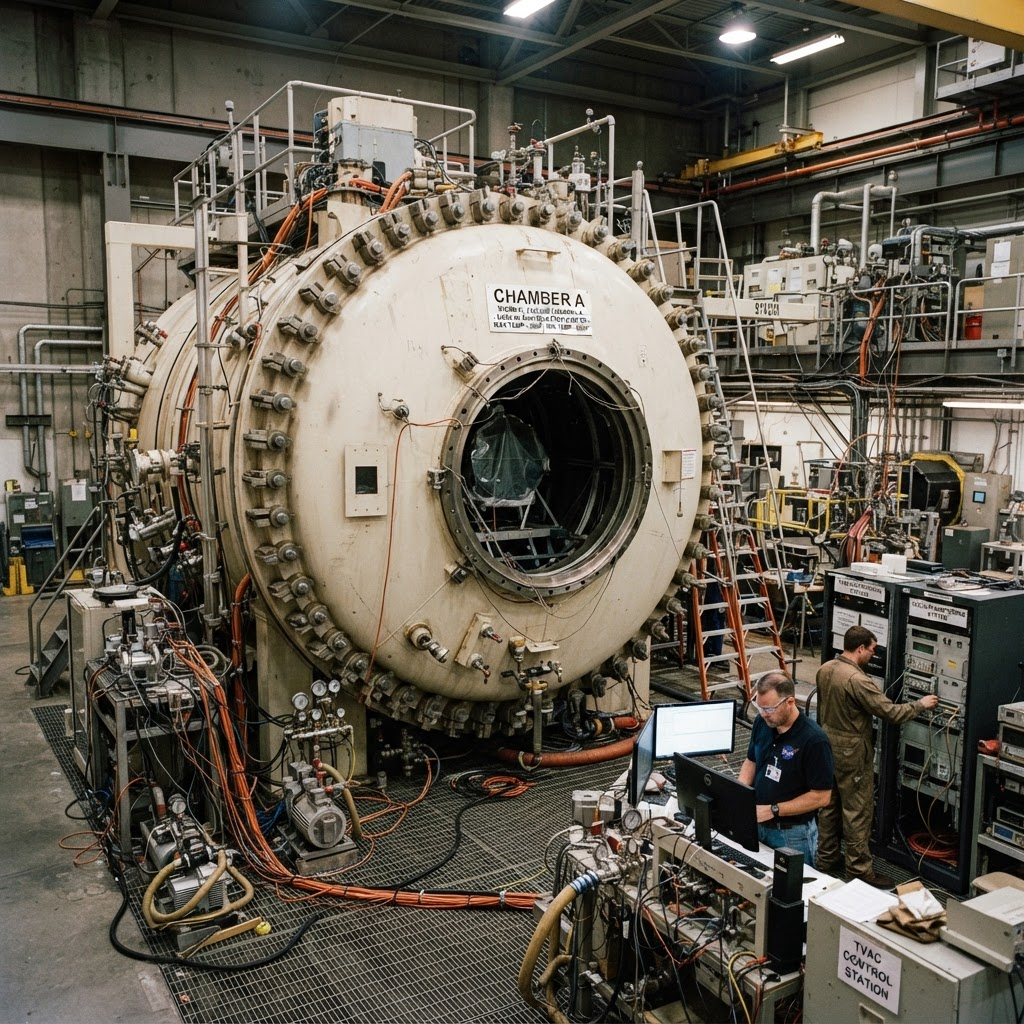
NASA SESL Vacuum Chamber — Altitude Test
NASA Space Environment Simulation Laboratory vacuum chamber used for suit testing. Decompression studies conducted here produced survivable, controlled exposures.
Verified Sources & Peer-Reviewed References
Human Exposure to Vacuum — Case Study
NASA JSC Medical Reports·1965Ebullism and Boiling Blood
Aviation, Space & Environmental Medicine·2000Decompression Sickness in Spaceflight
NASA Technical Memorandum·2015Physiological Limits in Hard Vacuum
Journal of Applied Physiology·2008
All sources are peer-reviewed or from accredited space agencies. Dark Myths does not fabricate or misrepresent scientific findings.