
Astronauts float because there is no gravity in space
Scientific Reality
The ISS is in constant free-fall — gravity is still ~88% as strong as on Earth's surface.
Historical & Cultural Context
For most of human history the cosmos was read through the naked eye and the stories cultures told to explain the night sky. As a question of physics, "Astronauts float because there is no gravity in space" slotted neatly into what people already expected to be true, which is exactly why it went unquestioned for so long.
Textbooks, science fiction, and secondhand summaries repeated the claim until it felt like settled fact. It was not until 1970 that the record was set straight — the ISS is in constant free-fall — gravity is still ~88% as strong as on Earth's surface. The correction came from NASA ISS Operations, Newton (1687), yet the original myth still lingers in everyday conversation.
A Different Lens
This myth is less about space itself and more about the limits of human perception and scale — our intuition simply was not built for cosmic distances. It persists by living in the comfortable middle ground between plausible-sounding and actually verified. Strip away the folklore and the sharper truth comes into focus — start with a single fact: iSS orbital velocity: ~7.66 km/s (27,600 km/h). Seen this way, the myth is less a mistake to mock than a case study in how belief outruns evidence.
Deep Dive
At 408 km altitude, gravitational acceleration is ~8.7 m/s² (vs. 9.8 m/s² at sea level). Astronauts 'float' because the station and everything inside is falling toward Earth at the same rate while moving fast enough sideways to keep missing it — that is what an orbit is.
- ISS orbital velocity: ~7.66 km/s (27,600 km/h)
- Gravity at ISS altitude: ~8.7 m/s² (88% of surface)
- Free-fall = apparent weightlessness
- A circular orbit is continuously "falling around" Earth
Visualization
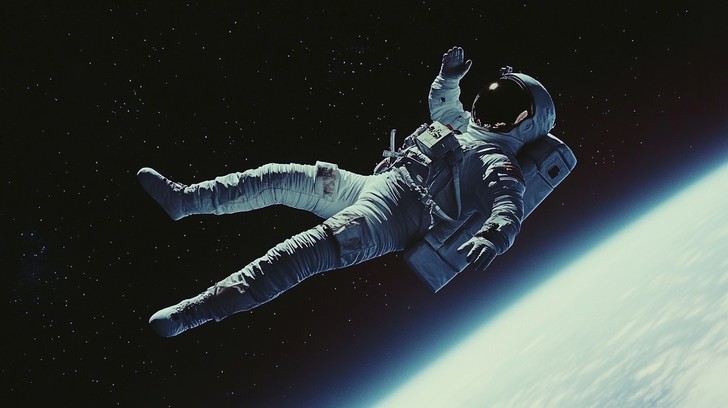
Astronaut Free-Float — Continuous Free-Fall Orbit Visualization
An astronaut floating freely in orbit above Earth's limb. The apparent weightlessness is not the absence of gravity — gravitational acceleration at ISS altitude is still ~8.7 m/s². Both astronaut and station are in continuous free-fall around Earth, producing the sensation of weightlessness.
Verified Sources & Peer-Reviewed References
Principia Mathematica — Law of Universal Gravitation
Isaac Newton / Royal Society·1687ISS Orbital Parameters
NASA JSC Mission Operations·2023Weightlessness and Free Fall
American Journal of Physics·2012Microgravity Science Overview
ESA Education·2019
All sources are peer-reviewed or from accredited space agencies. Dark Myths does not fabricate or misrepresent scientific findings.