Stars twinkle because they are pulsing
Scientific Reality
Stars are so far away they appear as point sources — atmospheric turbulence does the rest.
Historical & Cultural Context
For most of human history the cosmos was read through the naked eye and the stories cultures told to explain the night sky. As a question of observation, "Stars twinkle because they are pulsing" slotted neatly into what people already expected to be true, which is exactly why it went unquestioned for so long.
Textbooks, science fiction, and secondhand summaries repeated the claim until it felt like settled fact. It was not until 1704 that the record was set straight — stars are so far away they appear as point sources — atmospheric turbulence does the rest. The correction came from Newton, Opticks (1704); ESO Seeing Statistics, yet the original myth still lingers in everyday conversation.
A Different Lens
This myth is less about space itself and more about the limits of human perception and scale — our intuition simply was not built for cosmic distances. It survives not because it is convincing but because it is so rarely challenged out loud. Strip away the folklore and the sharper truth comes into focus — start with a single fact: scintillation index depends on star's altitude above horizon. Seen this way, the myth is less a mistake to mock than a case study in how belief outruns evidence.
Deep Dive
Stars don't physically pulse when we see them twinkle. Light from a star passes through multiple atmospheric layers at different temperatures, densities, and wind speeds. These cause rapid refraction variations — scintillation. From space, stars shine with perfect, unwavering steadiness. Planets twinkle far less because they subtend a visible disc.
- Scintillation index depends on star's altitude above horizon
- Planets appear as discs ~10–50 arcseconds wide — resistant to scintillation
- Hubble Space Telescope images stars without any twinkling
- Atmospheric seeing measured in arcseconds by observatories
Visualization
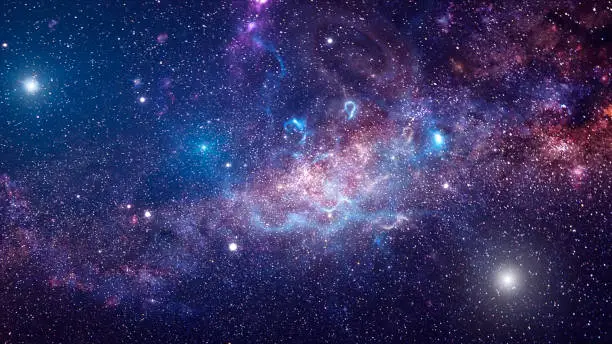
Deep Space Galaxy Field — iStock Blue-Pink Nebula Composite
Wide-field composite photograph of a galaxy field with blue and pink nebula regions. From space (above the atmosphere), every star in this image would appear as a perfectly steady point source. Twinkling (scintillation) is caused entirely by atmospheric turbulence — it is a property of Earth's air, not of the stars themselves.
Verified Sources & Peer-Reviewed References
Opticks — Book III
Isaac Newton / Royal Society·1704Stellar Scintillation Statistics
ESO La Silla Paranal Observatory·2018Atmospheric Seeing Models
Publications of the Astronomical Society·2009HST Image Quality Standards
Space Telescope Science Institute·2020
All sources are peer-reviewed or from accredited space agencies. Dark Myths does not fabricate or misrepresent scientific findings.