
Black holes suck everything in
Scientific Reality
Black holes only trap matter that crosses the event horizon — beyond that, orbits are stable.
Historical & Cultural Context
For most of human history the cosmos was read through the naked eye and the stories cultures told to explain the night sky. As a question of astrophysics, "Black holes suck everything in" slotted neatly into what people already expected to be true, which is exactly why it went unquestioned for so long.
Textbooks, science fiction, and secondhand summaries repeated the claim until it felt like settled fact. It was not until 1970 that the record was set straight — black holes only trap matter that crosses the event horizon — beyond that, orbits are stable. The correction came from Event Horizon Telescope (2019), Hawking (1974), yet the original myth still lingers in everyday conversation.
A Different Lens
This myth is less about space itself and more about the limits of human perception and scale — our intuition simply was not built for cosmic distances. It endures precisely because the real explanation is counterintuitive and takes genuine expertise to appreciate. Strip away the folklore and the sharper truth comes into focus — start with a single fact: event horizon of stellar black hole: ~10–100 km radius. Seen this way, the myth is less a mistake to mock than a case study in how belief outruns evidence.
Deep Dive
Black holes obey the same gravity laws as any mass. If our Sun were replaced by an equal-mass black hole, planets would orbit normally. Hawking radiation even causes black holes to slowly evaporate.
- Event horizon of stellar black hole: ~10–100 km radius
- Sagittarius A*: 4 million solar masses
- Hawking radiation: black holes slowly evaporate
- First image of black hole captured in 2019 (M87*)
Visualization
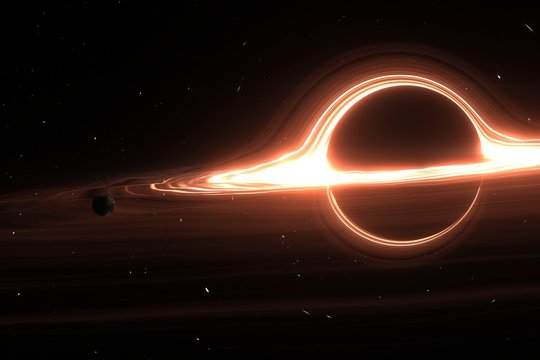
M87* Black Hole — Event Horizon Telescope Image
First direct image of a black hole: M87*, 6.5 billion solar masses. The bright ring is photons orbiting the event horizon.
Sagittarius A* — Gravitational Wave Ringdown
NASA Chandra / Event Horizon Telescope, 2022
NASA sonification of Sgr A* derived from Chandra X-ray data. Bursts correspond to accreting material near the event horizon.
Verified Sources & Peer-Reviewed References
First M87* Image — EHT Results
Event Horizon Telescope Collaboration·2019Hawking Radiation Theory
Communications in Mathematical Physics·1974Sgr A* Mass Measurement
The Astrophysical Journal Letters·2022Black Hole Orbital Mechanics
NASA Goddard SFC·2020
All sources are peer-reviewed or from accredited space agencies. Dark Myths does not fabricate or misrepresent scientific findings.