Shooting stars are actual stars
Scientific Reality
Meteors are mostly dust and pebbles vaporizing in Earth's atmosphere.
Historical & Cultural Context
For most of human history the cosmos was read through the naked eye and the stories cultures told to explain the night sky. As a question of observation, "Shooting stars are actual stars" slotted neatly into what people already expected to be true, which is exactly why it went unquestioned for so long.
Textbooks, science fiction, and secondhand summaries repeated the claim until it felt like settled fact. It was not until 1800 that the record was set straight — meteors are mostly dust and pebbles vaporizing in Earth's atmosphere. The correction came from IAU Meteor Data Center, ESA, yet the original myth still lingers in everyday conversation.
A Different Lens
This myth is less about space itself and more about the limits of human perception and scale — our intuition simply was not built for cosmic distances. It survives not because it is convincing but because it is so rarely challenged out loud. Strip away the folklore and the sharper truth comes into focus — start with a single fact: typical meteoroid: 1 mm to 1 cm in size. Seen this way, the myth is less a mistake to mock than a case study in how belief outruns evidence.
Deep Dive
Meteoroids range from microscopic dust to fist-sized rocks burning up 80–120 km above Earth. The streak is ionized air glowing from friction. Actual stars are 4 to thousands of light-years away.
- Typical meteoroid: 1 mm to 1 cm in size
- Entry speed: 11–72 km/s (40,000–260,000 km/h)
- Burn-up altitude: 80–120 km above Earth
- Earth collects ~100 tonnes of space debris daily
Visualization
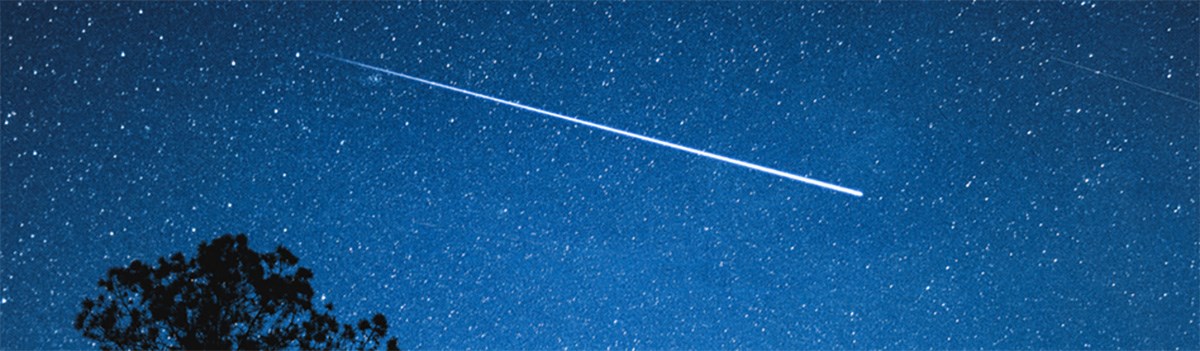
Leonid Shooting Star — Long-Exposure with Tree Silhouette
Long-exposure photograph capturing a brilliant shooting star streak across a star-filled night sky, with a tree silhouette below. The streak is ionized air glowing from a 1–10 mm meteoroid ablating at 70–80 km/s — not a falling star, which would be millions of km across.
Verified Sources & Peer-Reviewed References
Leonid Meteor Storm Analysis
IAU Meteor Data Center·2002Meteoroid Environment Overview
NASA MSFC·2021Atmospheric Entry Physics
Journal of Geophysical Research·2015ESA Space Debris Model
ESA ESOC·2023
All sources are peer-reviewed or from accredited space agencies. Dark Myths does not fabricate or misrepresent scientific findings.