
The Sun is on fire
Scientific Reality
Nuclear fusion — 620 million tonnes of hydrogen fused every second.
Historical & Cultural Context
For most of human history the cosmos was read through the naked eye and the stories cultures told to explain the night sky. As a question of astrophysics, "The Sun is on fire" slotted neatly into what people already expected to be true, which is exactly why it went unquestioned for so long.
Textbooks, science fiction, and secondhand summaries repeated the claim until it felt like settled fact. It was not until 1938 that the record was set straight — nuclear fusion — 620 million tonnes of hydrogen fused every second. The correction came from Hans Bethe (1938), ESA Solar Orbiter (2022), yet the original myth still lingers in everyday conversation.
A Different Lens
This myth is less about space itself and more about the limits of human perception and scale — our intuition simply was not built for cosmic distances. It persists by living in the comfortable middle ground between plausible-sounding and actually verified. Strip away the folklore and the sharper truth comes into focus — start with a single fact: core temperature: ~15,000,000 °C. Seen this way, the myth is less a mistake to mock than a case study in how belief outruns evidence.
Deep Dive
Combustion requires oxygen, which the Sun's core lacks. What we see is plasma superheated to ~15 million °C by nuclear fusion. Energy released follows E=mc² at ~3.8×10²⁶ W. Fire never exceeds ~2,000 °C; the photosphere glows at ~5,500 °C.
- Core temperature: ~15,000,000 °C
- 4 million tonnes of mass converted to energy per second
- Photons take ~100,000 years to escape from core to surface
- Nuclear fusion identified by Hans Bethe in 1938
Visualization
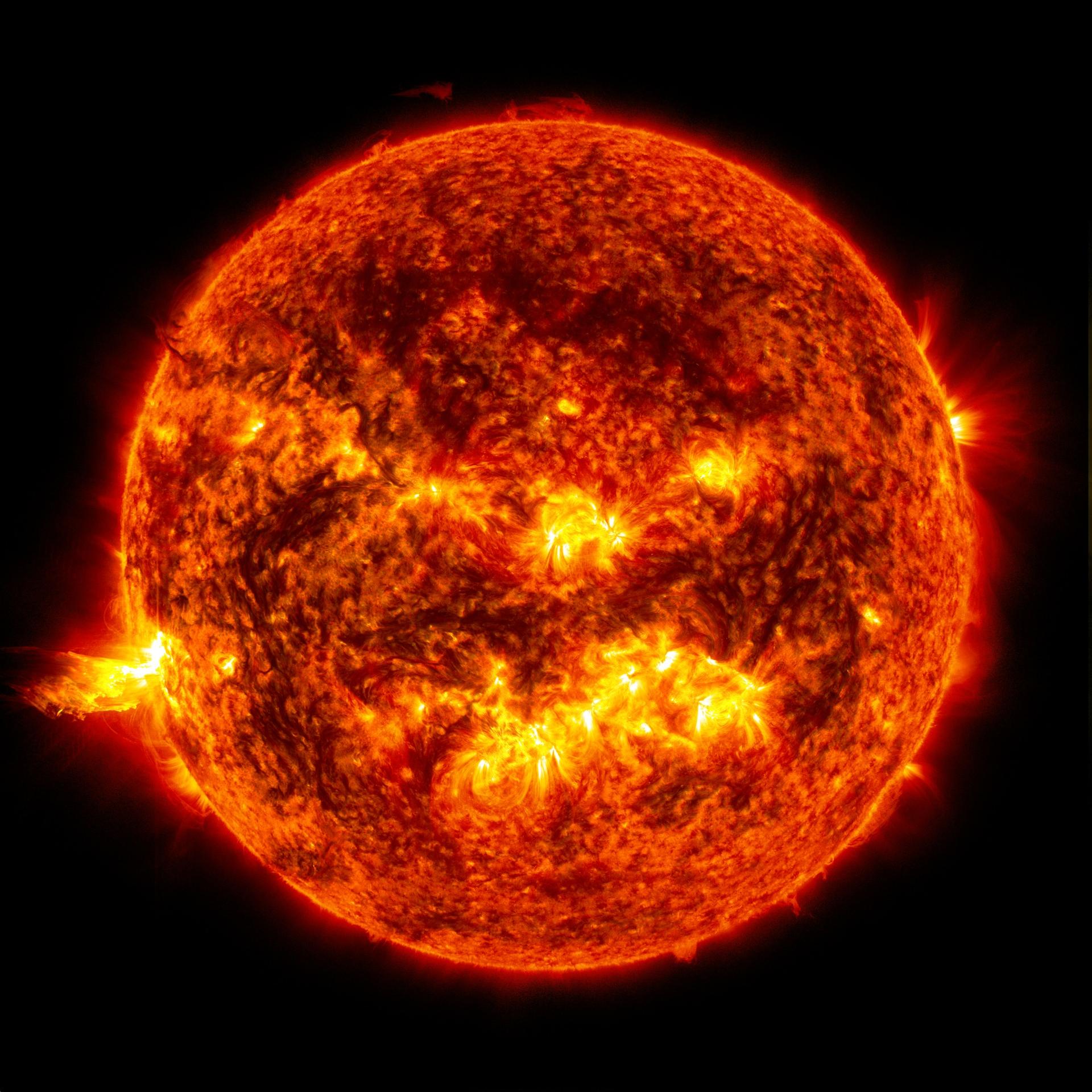
NASA SDO — Solar Flares and Coronal Mass Ejections
NASA Solar Dynamics Observatory image showing the Sun with visible solar flares and plasma eruptions. The surface temperature is ~5,500 °C — far exceeding any combustion reaction — confirming nuclear fusion as the energy source, not fire.
Verified Sources & Peer-Reviewed References
Energy Production in Stars
Physical Review·1938Solar Orbiter First Results
ESA / NASA·2022Helioseismology Overview
Stanford Solar Center·2018Solar Fusion Rate Measurements
Borexino Collaboration·2020
All sources are peer-reviewed or from accredited space agencies. Dark Myths does not fabricate or misrepresent scientific findings.