
The pyramids of Giza were built by aliens
Scientific Reality
Archaeologists have found the quarries, tools, ramps, and the towns of the paid workers who built them.
Historical & Cultural Context
Passed down from antiquity through oral tradition and early chroniclers, the story gathered embellishments with every retelling. As a question of archaeology, "The pyramids of Giza were built by aliens" slotted neatly into what people already expected to be true, which is exactly why it went unquestioned for so long.
Distance in time let speculation calcify into "what everyone knows" about the ancient world. It was not until 1990 that the record was set straight — archaeologists have found the quarries, tools, ramps, and the towns of the paid workers who built them. The correction came from Lehner, M. — The Complete Pyramids (1997); Tallet, P. — Les Papyrus de la Mer Rouge (2017), yet the original myth still lingers in everyday conversation.
A Different Lens
We project our own assumptions backward onto the ancients. This myth shows how the past becomes a mirror for the present. It survives not because it is convincing but because it is so rarely challenged out loud. Strip away the folklore and the sharper truth comes into focus — start with a single fact: workers' town with bakeries and clinics excavated at Giza. Seen this way, the myth is less a mistake to mock than a case study in how belief outruns evidence.
Deep Dive
The Great Pyramid was built c. 2560 BCE by the ancient Egyptians, and the evidence is abundant. Archaeologists have excavated the workers' town at Giza, complete with bakeries, breweries, and medical facilities, showing a skilled paid workforce — not slaves and certainly not aliens. Papyri (the Diary of Merer, discovered 2013) document teams transporting limestone by boat. Tool marks, unfinished quarry blocks, and experimental archaeology demonstrate copper tools, wooden sledges, water-lubricated sand, and ramps were sufficient. The 'aliens' claim relies on underestimating ancient engineering and ignoring a vast, coherent archaeological record — a view many consider to diminish a remarkable human achievement.
- Workers' town with bakeries and clinics excavated at Giza
- Diary of Merer (2013) records limestone transport by boat
- Copper tools, sledges, and wetted sand demonstrated experimentally
- Built c. 2560 BCE by a skilled, paid Egyptian workforce
Visualization
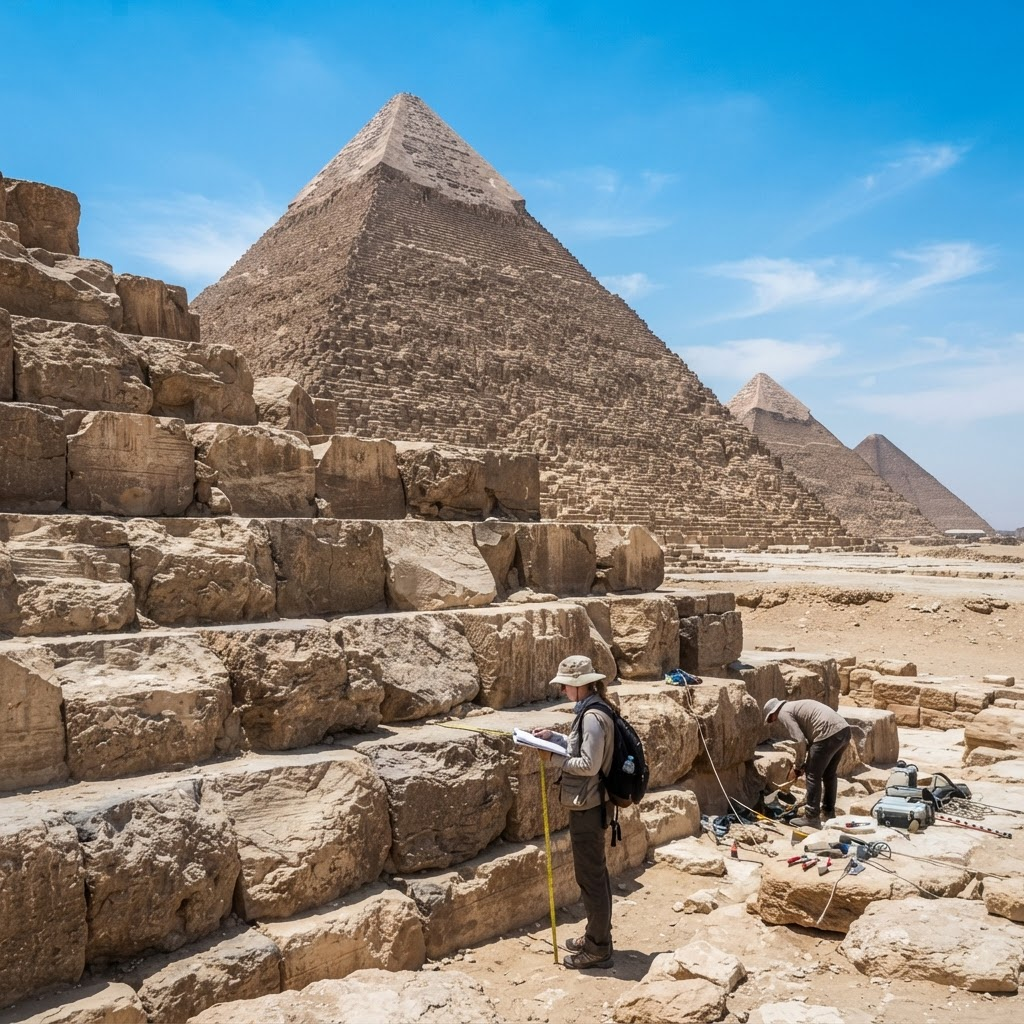
Giza Plateau — Great Pyramid and Excavated Worker Town
The pyramids of Giza alongside the extensively excavated workers' settlement. Bakeries, breweries, clinics, and administrative papyri document the human labour force that quarried, hauled, and assembled the monuments.
Verified Sources & Peer-Reviewed References
The Complete Pyramids
Thames & Hudson·1997Les Papyrus de la Mer Rouge (Diary of Merer)
Institut Français d'Archéologie Orientale·2017The Lost City of the Pyramid Builders
Ancient Egypt Research Associates·2002Experimental Archaeology of Monument Construction
Journal of Archaeological Science·2014
All sources are peer-reviewed or from accredited space agencies. Dark Myths does not fabricate or misrepresent scientific findings.