Cursed objects cause real harm to their owners
Scientific Reality
The "Curse of Tutankhamun" is a textbook case of survivorship bias and media fabrication.
Historical & Cultural Context
Rooted in folklore and campfire storytelling, the belief thrived in the gap between the unexplained and the merely unfamiliar. As a question of folklore, "Cursed objects cause real harm to their owners" slotted neatly into what people already expected to be true, which is exactly why it went unquestioned for so long.
Fear, suggestion, and a good scare travel faster than any rational correction. It was not until 2002 that the record was set straight — the "Curse of Tutankhamun" is a textbook case of survivorship bias and media fabrication. The correction came from Nelson, M.R., British Medical Journal (2002); Luckhurst, R. — The Mummy's Curse: The True History (2012), yet the original myth still lingers in everyday conversation.
A Different Lens
The paranormal is where the brain fills darkness with pattern. This myth is a window into how readily we manufacture certainty from ambiguity. It survives not because it is convincing but because it is so rarely challenged out loud. Strip away the folklore and the sharper truth comes into focus — start with a single fact: 58 people attended the 1922 Tutankhamun tomb opening. Seen this way, the myth is less a mistake to mock than a case study in how belief outruns evidence.
Deep Dive
Howard Carter opened Tutankhamun's tomb in November 1922 with a team of 58 people. The "curse" narrative was invented by novelist Marie Corelli before any deaths occurred. Of the 58 present at the opening, only 8 died within a decade — a mortality rate consistent with or below expectations for their age and health profiles. Carter himself, the primary violator of the supposed curse, lived until 1939 — 17 years after the opening. A 2002 analysis of all documented tomb-expedition members found no statistically significant excess mortality. The "mummy's curse" persisted because newspapers published deaths and ignored survivals.
- 58 people attended the 1922 Tutankhamun tomb opening
- Howard Carter, the lead violator, lived 17 more years — died of lymphoma at 64
- 2002 study: no statistically significant excess mortality among tomb expedition members
- Lord Carnarvon died of an infected mosquito bite — unrelated to any curse mechanism
Visualization
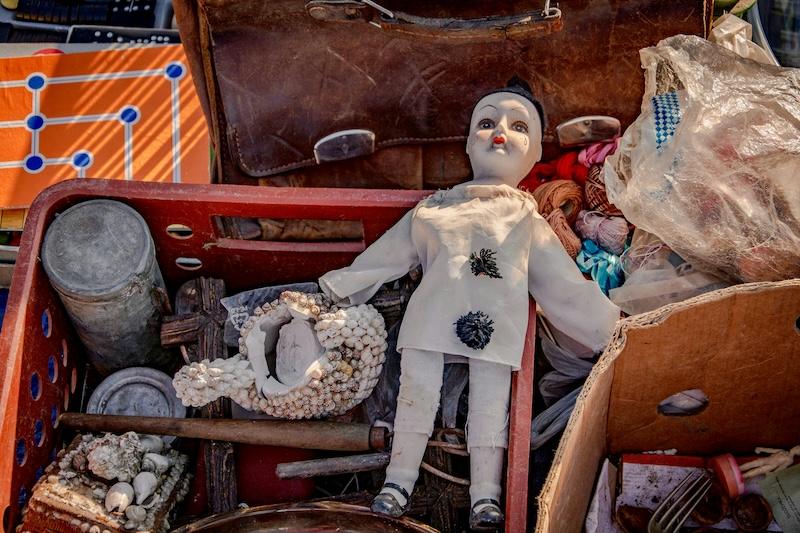
Antique Doll in Flea Market — Creepy Aesthetic, Mundane Object
An unsettling antique doll among flea market clutter. The "cursed object" experience is well-explained psychology: apophenia (pattern-seeking), classical conditioning, and confirmation bias cause people to attribute unrelated negative events to a salient object. The BMJ 2002 study found no excess mortality among Tutankhamun's "cursed" excavators.
Verified Sources & Peer-Reviewed References
The Mummy's Curse: Historical Cohort Study
British Medical Journal·2002The Mummy's Curse: The True History of a Dark Fantasy
Oxford University Press·2012Confirmation Bias in Paranormal Belief
Cognition·2009Howard Carter Biography and Tutankhamun Discovery
Griffith Institute, Oxford·2015
All sources are peer-reviewed or from accredited space agencies. Dark Myths does not fabricate or misrepresent scientific findings.